When you first step into the world of content marketing, you only need to know the basics: how to write a decent piece of content (or source one), how to publish it on your blog, and how to distribute it through your social media channels. It's possible to build a foundation for any successful content campaign this way, but if you want to scale up your reach or start seeing a significant return on your investment, you'll need to step up your game.
As marketers need to compete in an increasingly saturated landscape—and as new technologies such as generative AI reshape the industry—content marketers must develop a more well-rounded set of marketing skills. The following seven content marketing skills will help you elevate your blog posts, improve your content strategy, strengthen your content creation process, and ultimately achieve better results in both the short and long term. In addition, they need to be aware of how each of these skills works together in a cohesive strategy that evolves alongside market behavior, audience expectations, and digital trends.
Below is a deeper look into each skill, how it functions within a modern content strategy, and why marketers must elevate these abilities if they want to become truly adept in today’s competitive environment. As the field of content marketing continues to expand, professionals must understand the depth and versatility of the discipline to create meaningful outcomes.
The ability to research manifests itself in two applications, both of which are important to the quality of your content creation: primary and secondary research. Secondary research is easier, less intensive, and applicable to more kinds of content. It involves scouring the web for outside sources that confirm, deny, or otherwise complement the claims you're trying to make.
Finding more of these sources (and higher authority ones at that) makes your content better-rounded, more thoroughly documented, and, of course, more trustworthy for the reader. Primary research is all firsthand audience research you've done yourself, such as a survey you've conducted or an experiment you've run. This type of original research takes time and money, but it's important to incorporate it in creating content, as it tends to produce highly original, highly valuable content.
Research is also fundamental to forming an informed strategy. When marketers need to build campaigns that resonate, they must rely on data rather than guesswork. Audience personas, keyword analysis, competitor research, and search intent mapping all contribute to a stronger foundation. A content strategy built on thorough research helps marketers anticipate what the audience needs before they articulate it themselves.
This is one of the reasons why research sits at the core of content marketing. With more brands than ever producing blogs, videos, and social content, the quality bar has risen significantly. Content marketing succeeds when it elevates information, clarifies complex ideas, or presents findings viewers cannot find elsewhere. That level of impact depends heavily on advanced research habits.
Flexibility isn't a critical skill like research because you can't practice it or learn more about it unless you're confronted with a situation that demands it. Flexibility comes in a variety of forms; for example, you might see a handful of user comments in a short period of time asking your brand for coverage of a particular event or subject you'd otherwise avoid.
Responding positively may be a deviation from your core strategy, but it will give your users more of what they want. You may also find a new type of content or new platform surging in popularity; flexible content marketers adopt these new opportunities seamlessly.
For instance, if a blog post suddenly becomes popular, it might be wise to integrate similar topics into your overall marketing strategy. Flexibility in your marketing campaigns can also mean quickly adapting to trends to create high-quality content that resonates with your audience.
Flexibility also plays a major role in long-term strategy planning. The digital landscape evolves rapidly, and content strategies that were effective a year ago may be outdated today. Marketers need to remain adaptable, continually testing new angles, content formats, and distribution tactics. When done well, flexibility strengthens the long-term scalability of your content strategy by allowing you to seize opportunities as they arise rather than only reacting to them after the fact.
This adaptability is especially important in content marketing, where platform algorithms, user preferences, and emerging technologies can shift unexpectedly. Content marketing thrives when teams adjust quickly instead of clinging to outdated tactics.
As your content promotion gets bigger and starts to cover more ground, the need for high organization skills and project management skills increases. You'll need to organize your schedule and pattern of publication, your research leading up to your drafts, your drafts leading up to your final version, and even all your past posts for future updates and syndication needs. Without that organization, you may post inconsistently or fail to follow up on key opportunities that could lead to more organic traffic and a more loyal audience.
Good organization also improves collaboration with team members across SEO, design, and strategy. Content marketers frequently rely on tools like editorial calendars, workflow software, and automation apps to streamline processes and maintain consistency. Solid management ensures nothing slips through the cracks.
Incorporating strong organization into your strategy also enhances your ability to scale. The more detailed and structured your publishing process becomes, the easier it is to sustain content output over long periods of time. Marketers need consistency to build trust with their audiences, and organization is the operational backbone that allows that consistency to flourish.
Organization also allows marketers to maintain a repository of assets, insights, performance reports, and reusable templates. This becomes invaluable as content strategy efforts expand across multiple campaigns, audiences, and platforms. Brands that stay organized can produce high-performing content marketing campaigns month after month.
Every digital asset has a natural lifespan. Articles, videos, and downloadable resources gradually lose relevance unless they are updated or repurposed. Establishing a routine for reviewing older materials ensures that your library remains valuable over time. Teams that regularly refresh their archives maintain stronger performance without the need to constantly develop brand-new material from scratch. This process also reveals opportunities for improvements or expansions that may not have been apparent during the original creation.
Persuasion becomes more important as your audience becomes larger and your content strategy campaign demands a higher return. On a pure content level, persuasion is especially important for opinion posts or ones that share insights.
You'll need to use your words carefully, demonstrating personal experience and authority, emotional appeals, and raw logic to convince your target audience that your views are correct (or at least worth considering). On another level, you'll need to be persuasive in the calls to action you'll periodically embed in the body of your content. Leading users to conversion, or another part of your site, is essential if you want to start cashing in on your efforts.
Persuasion also plays an influential role in long-term strategy alignment. If you want to encourage users to subscribe, revisit your content, follow a series, or engage with your brand across channels, your messaging must be compelling and strategically structured. Strong writing skills further enhance your ability to persuade by ensuring clarity, coherence, and emotional connection.
The most effective content strategies use persuasion to guide readers through a journey rather than simply presenting information. Persuasion sits at the heart of successful content marketing because your content must not only inform—it must influence.
Experimentation allows teams to uncover new possibilities that traditional approaches might miss. Small tests—such as trying alternative visual layouts, testing different narrative structures, or adjusting how information is presented—often reveal surprising insights about audience behavior. While not every experiment leads to dramatic results, the collective knowledge gained over time creates a clearer path for long-term planning. This scientific mindset ensures that decisions are informed by real outcomes rather than assumptions.
Good content marketers are able to respond to new trends with new strategies and a new frame of mind. Successful content marketers are able to predict those trends and make changes before they ever get established. Because the content marketing game changes often and without warning, these changes are hard to predict, but if you look at historical patterns and pay close attention to marketing news, you should gradually build your ability to identify upcoming changes. Connect and engage with other influencers, and try to stay at least on their level—if not a little ahead of them.
Prediction is a powerful differentiator in content development. Marketers need foresight to plan content calendars, resource allocation, promotional timing, and strategic positioning. Incorporating predictive thinking into your strategy enables your brand to meet users where they're heading—rather than where they’ve been.
A strong predictive approach also helps marketers identify content gaps, emerging subtopics, shifts in search intent, and industry transformations early. This strategic advantage allows your content strategy to evolve ahead of the competition.
In content marketing, prediction sets the stage for thought leadership. When your brand consistently anticipates what audiences will need next, your content marketing efforts become more timely, relevant, and respected.
Content marketing strategy can't be pigeonholed into serving only one function. It's important and necessary for sales, Search Engine Optimization, social media marketing, general digital marketing, user experience improvement, and a dozen other applications. Knowing all these individual applications is overwhelming (if not impossible) for new content marketing specialists, but as you become more adept, it's reasonable and expected for you to be at least somewhat familiar with them. Start talking to other experts in these areas and immerse yourself in all the different functions that content creation can serve.
Staying updated on industry trends will give you a deeper understanding of the evolving landscape, allowing you to generate leads more effectively. Broadening your knowledge and key skills across these areas, you'll be better equipped to create content that aligns with your business objectives and resonates with your target audience.
Interdepartmental awareness ensures your strategy works in harmony with the broader organization. Marketers need this alignment to produce content that supports every stage of the customer journey—from awareness to decision-making. When content strategy aligns with UX teams, sales teams, branding teams, and analytics teams, the impact multiplies.
This cross-functional understanding helps content perform better, improves user satisfaction, and creates more opportunities for growth. In large-scale content marketing operations, this alignment often determines whether content succeeds or underperforms.
Modern digital work rarely happens in isolation. Teams often interact with colleagues in user research, analytics, branding, service design, and customer support. These interactions provide a fuller picture of how people perceive and experience a brand. Regular collaboration—whether through brainstorming sessions, shared dashboards, or creative workshops—helps break down silos and encourages more cohesive decision-making. Stronger communication between teams makes it easier to deliver experiences that feel consistent across touchpoints.
It's one thing to take elementary measures, like how many people visited your site compared to the previous period, but it's another thing entirely to run a specific data analysis for why a metric like that would have changed.
You're getting more people, but why? Did you rise in search engine ranks? Why? Did they come from social media platforms? Why? Answering these questions isn't easy, and it's rarely straightforward, but you'll have to answer them if you want to continue honing your craft. To guide yourself, start setting up your efforts in easily comparable experiments—at least until you get better at reading and interpreting the raw data.
Deep analysis is not just a reporting function—it’s a core element of successful content strategy development. You cannot refine your strategy without knowing which elements work, which fail, and which require rethinking. Marketers need data-driven insights to guide their decisions, allocate resources properly, and prioritize high-impact opportunities.
Data analysis informs everything from keyword targeting and content type selection to channel distribution and conversion optimization. A strong analytical approach makes your content strategy more efficient and future-proof.
Technical accuracy is essential, but emotional connection plays an equally important role in how people respond to information. Tone, pacing, phrasing, and narrative arc can greatly influence whether someone feels understood and valued. Professionals with strong sensitivity to these elements tend to develop work that resonates more deeply. By considering how readers feel—not just what they think—creators can shape experiences that encourage reflection, trust, and engagement.
Whether you're transitioning from beginner to intermediate or simply refining your existing abilities, these seven content marketing skills should be your priority. Combined with strong communication, strategic thinking, and effective project management, they help content marketers build sustainable success over the long term.
To build on these seven essential abilities, it's worth recognizing that mastery in this field is not something achieved overnight. It grows through deliberate practice, exposure to real-world challenges, and consistent reflection on what works and what doesn’t. Professionals who advance most quickly tend to maintain a habit of ongoing education—whether through industry publications, online communities, conferences, or mentorship opportunities. Because digital environments evolve quickly, those who commit to continuous learning place themselves at a significant advantage.
Practice these skills consistently, leverage tools like analytics software and AI-powered platforms, and collaborate effectively with your team members. Over time, your content strategy will become more efficient, more impactful, and far better equipped to adapt to the ever-changing world of content marketing.
By committing to ongoing improvement, staying informed about industry changes, and treating content marketing as a long-term strategic investment, you’ll position yourself—and your brand—to thrive in the evolving digital landscape.

You don't build successful, intimate, beautiful relationships overnight.
Instead, you build them over the course of hundreds, if not thousands of little interactions that eventually aggregate into a fuller picture of the relationship as a whole.
Similarly, although it's possible for businesses to immediately persuade and win the business of certain target customers, it's much more effective for those businesses to build relationships and create lasting relationships with their customers over the course of several interactions.
This is, essentially, the idea behind an effective lead nurturing strategy.
For many businesses, lead nurturing represents the bridge between initial interest and a completed sale. It’s the difference between non nurtured leads that fade away and sales-ready leads that convert reliably.
But what exactly does it mean to nurture leads?
Why is it so important?
And how can you get the most out of lead nurturing for your business?
In this guide, we’ll explore what lead nurturing means, why it’s essential, and how you can design a lead nurturing program that moves prospects from first contact to purchase while strengthening your brand relationships along the way.
You’re probably familiar with the basics of lead generation.
Basically, it's the process of generating new interest in your product or service. We use a ton of tactics for lead generation, including cold calling, cold emailing, social media, content marketing, email marketing, and much, much more. If you're like most businesses in the modern era, you're doing something similar.
But the story doesn’t end there. The lead nurturing process begins after those leads enter your funnel. It’s about maintaining communication, providing value, and guiding potential buyers and customer segments toward a buying decision.
Unfortunately, many businesses have a simplistic, black and white approach. They reach out to leads or otherwise get them to a website, hope that each lead makes a purchase, and then discard any leads that don't successfully convert.
On some level, it's easy to see why this is the impulse. After all, if someone is interested in buying from you, why would you keep bugging them?
But the reality is much more complex. A person may have any number of reasons for not buying from you. Maybe it's not the right time. Maybe they don't have the money. Maybe they're on the fence between you and a competitor. Maybe they simply forgot to finalize the transaction. Maybe they're not familiar enough with your brand and they want to get to know you better before they follow through.
The solution to all of these “maybes” is lead nurturing, the ongoing process of communicating with and connecting to people with a relatively high likelihood of successfully becoming your customers. Rather than discarding those contacts, nurturing leads keeps them engaged until they’re ready to act.
As we'll see, an effective lead nurturing strategy can take many forms, but it's always focused on intermittently and consistently reaching out to leads, including those who have converted and those who have not. The end goal is to get these people more familiar and acquainted with your brand, motivate them to proceed to the next stage through the sales funnel, and ultimately guide them to conversion.
We've seen a number of successful lead nurturing campaigns that have multiplied conversions many times over. It's a simple additional measure that can make your lead generation efforts much more beneficial. The goal isn’t just conversion; it’s to build solid relationships that transform future customers into loyal customers and brand advocates.

When done successfully, a lead nurturing program can be one of your most powerful marketing strategies. It strengthens customer relationships, increases conversions, and enhances overall ROI.
It can help you with:
· Keeping the sales funnel moving. The sales funnel isn't some stagnant, unmoving entity. It's a series of ever-moving processes. If you want to keep your sales funnel moving, you'll need to continuously reignite the momentum of your leads and push leads who haven't acted or converted to either take action or remove themselves from your funnel. Without an ongoing lead nurturing strategy, this momentum can quickly subside.
· Increasing the value of each lead. When executed properly, lead nurturing programs can help you increase the average value of each lead in your pipeline and your return on marketing efforts. Instead of simply dropping off the map, each lead has practically countless opportunities for engaging with your brand and buying from it. Each interaction increases the likelihood that your sales teams will eventually connect with a qualified, sales-ready lead. If you can recapture even a portion of leads who didn't convert initially, you can greatly increase the overall payoff of your lead generation strategy. With the right CRM system and key elements in place, you can turn interest into conversions and drive more revenue.
· Improving brand visibility and reputation. Even if your lead nurturing strategy doesn't result in many conversions directly, it can benefit your organization by improving your brand visibility and reputation. Effective nurturing strategies make your company brand top of mind, more recognizable, and trusted. Over time, this builds awareness, brand advocacy, and authority within your industry.
· Gathering more data. One underrated benefit of a well-structured lead nurturing program is its ability to provide you with prospect information and more data on your customers and refine your marketing automation and outreach. By consistently interacting with your leads and paying attention to how they engage with your brand across multiple channels and social channels and direct mail, you can learn more about what they value, how they feel about your brand, and how best to appeal to them and target for even more effective lead nurturing. Just be aware that this benefit only exists if you're taking appropriate measurements and acting on your new insights.
There’s no single formula for effective lead nurturing, but several proven lead nurturing tactics consistently deliver results. These can work independently or together as part of a broader lead nurturing strategy.
These are some of the most common channels and tactics to use:
· Drip email campaigns. One of the most common methods of lead nurturing is using a drip email campaign. It's inexpensive, it's capable of being automated, and it can be highly personalized and customized so that it's more relevant for each individual customer. When paired with lead scoring, these campaigns ensure your best leads receive the most personalized attention. Even if you plan on using other channels, you can use this as the backbone of your lead nurturing campaign. Email marketing in this context becomes one of the key elements of moving prospects along their journey.
· Email segmentation and personalization. In line with this, you should also take advantage of email segmentation and personalization. To truly connect, your lead nurturing process must prioritize personalization. Segmenting by demographics, interests, or behavior allows your marketing teams to deliver relevant content that resonates with each audience segment. Every time we've made the effort to segment lists and personalized messages, we've been happy with the results. Well-segmented emails that address relevant topics help prospects progress from one stage to the next stage in the buying process.
· Remarketing/retargeting. Nurturing leads doesn’t stop with email. Remarketing and retargeting are essentially strategies designed to advertised directly to people who have already interacted with your brand in some way. For example, you might remind a customer that they have products in a cart on your website. This gentle reminder often nudges potential customers and potential buyers back into the sales cycle.
· Social media marketing. You already know that social media is a powerful channel for marketing and sales, but it’s also important for nurturing strategies. It's one of the easiest and least expensive ways to interact with your customers directly. Encourage followers to engage with educational posts, polls, or short videos that align with your marketing efforts and appear consistently across your social channels.
· Phone calls. Depending on the nature of your business, direct contact from a sales rep can make all the difference. Strategic phone calls can add a personal touch that automation can’t replicate. Even a brief follow-up can demonstrate attentiveness and accelerate movement through the sales process, leading to more leads and new business opportunities.
· Content marketing. Compelling, valuable content lies at the heart of every effective lead nurturing strategy. Hosting webinars, distributing white papers, and sending out educational materials can all help you demonstrate your expertise and authority while simultaneously keeping your leads better acquainted with your brand.
Address common pain points and provide solutions that show you understand your customers’ needs and desired product features. You can also devise different types of lead nurturing campaigns, and use several of them in conjunction with each other to get the best possible results.
Different goals call for different nurture programs. You can mix and match based on your target audience and buyer’s journey stage or even adapt to the consideration stage of your buying process.
· The welcome series. A common approach is to welcome new people to your brand community with a series of emails, phone calls, or other interactions designed to make them more familiar with your business. You can teach them how to use your app or website, give them helpful tip sheets for how to get started, explain the details of your product or service, or simply tell them what your brand is all about. A good lead nurturing program begins with setting expectations and offering early value — perhaps an educational resource or a quick-start guide. This helps to build relationships and lays the foundation for customer loyalty.
· Reengagement campaigns. Reengagement campaigns are more focused on interacting with leads who have already interacted with your brand in a substantial way, but who have not become full-fledged customers. For example, they may have had ongoing conversations with salespeople or put products in their cart, without ever finishing a full transaction. For dormant or non nurtured leads, these nurturing messages can focus on reigniting the initial spark, sending out reminders, or introducing people to new possibilities they haven't considered. With the right CRM system, they can be pulled back into your sales cycle, unlocking higher revenue potential.
· Deep dives and information. Some marketing teams focus on doing deep dives and sending out more information on products, services, or various problems their brand is trying to solve. For example, if you own a company that sells emergency supplies, you might have a campaign focused on distributing information related to survival or stockpiling. Sharing high-value information builds authority, supports brand advocacy, and reinforces an effective lead nurturing reputation.
· The omnichannel approach. An omnichannel lead nurturing strategy integrates multiple channels — email, social, ads, and direct contact — ensuring your brand remains visible regardless of where the buying journey takes place. Rather than committing to a single, linear path of communication, you can keep your brand top of mind regardless of where your leads interact on a regular basis.
· Promotional campaigns. You may also practice lead nurturing through promotional campaigns. Offering sales, discounts, direct mail, and other specials can catch the eye of people who have considered your brand in the past without moving forward. Timely offers and incentives keep potential customers engaged and moving toward conversion. Used sparingly, promotions can create urgency without overwhelming your audience and result in more revenue from reactivated leads.
Crafting a high-performing lead nurturing strategy requires planning, tools, and alignment across your organization. Here are the most critical steps.
· Acquire (and use) the right tools. We found lead nurturing much easier once we started using the right tools. Modern marketing automation platforms simplify lead nurturing efforts by handling repetitive tasks and tracking engagement. A strong CRM system can help your sales reps and marketing teams coordinate efficiently, ensuring a seamless sales process. Finding and tracking your leads effectively, automating communications, and appropriately measuring and analyzing your results are all critical for success and can generate more leads over time.
· Get to know your target audience. You also need to be intimately familiar with your target audience. If you don't know who your customers are, what they value, or what types of messages are relevant to them, none of your lead nurturing strategies are going to pay off. Before you can deliver relevant content, you must develop buyer personas that reflect your customers’ demographics, behaviors, and pain points. This foundation shapes every aspect of your nurturing strategies and helps you identify which customer segments are the most valuable.
· Document your customer journey. You also need to thoroughly understand your unique buyer's journey. What does the average person go through when they consider products and services like yours? What do they think about? What major obstacles do they encounter? What keeps them moving through the sales funnel and how do you exploit that? From awareness to the consideration stage, evaluation, and purchase, mapping out this progression helps tailor your lead nurturing tactics to meet prospects where they are in the buying process.
· Account for all available channels. You don't need to use every communication channel in your strategy, but you're doing yourself a disservice if you write any of them off immediately. Thoughtfully consider all available communication channels as part of your lead generation efforts. These could include LinkedIn, Facebook and other social media channels, as well as direct mail outreach. The more cohesive your nurture programs, the stronger your results.
· Create compelling content. Compelling, valuable content can make lead nurturing much more effective. What qualifies as compelling changes slightly from industry to industry, but the hallmarks are always the same. Your content needs to be relevant, original, well-researched, and focused if you want it to make an impact. Whether it’s a tutorial, whitepaper, or video case study, make sure every asset supports your lead nurturing efforts and provides genuine value. If you focus on relevant topics that help prospects understand your product or service, you’ll naturally build trust and accelerate the buyer's journey.
· Score your leads. Different leads have different value to your organization, so make sure you use a consistent, objective scoring system. This way, you can focus on your most valuable leads and filter out irrelevant parties from your lead nurturing system. By scoring based on prospect information, engagement, and product features interest, you’ll better identify the right person to contact at the next stage of their decision.
· Automate everything you can. Automation keeps your lead nurturing program consistent and scalable. Marketing automation tools can trigger personalized messages based on customer behavior, ensuring timely follow-up throughout the buying process. This level of automation not only increases conversion efficiency but also unlocks greater revenue potential.
· Measure your results. Always objectively measure your results. Are people persuaded or at least entertained by your content? How many of your leads are you able to recover? Track key metrics such as open rates, conversion rates, and pipeline velocity. Over time, you’ll discover which nurturing strategies generate the most effective leads and shorten your sales cycle. These insights help you uncover key elements that drive customer loyalty and more revenue.
· Experiment and improve. Finally, be willing to experiment and apply new insights from those experiments. If you change the angle of your messaging and align sales and marketing objectives, do your leads respond more favorably? If you employ a different communication channel, do you get better overall results? Each experiment provides prospect information you can feed back into your CRM system to improve performance and earn loyal customers.
You can also use these extra tips for success:
· Nail the timing. Timing can make or break your lead nurturing efforts. If you reach out to your leads too frequently, they could become annoyed at your presence and unsubscribe from your mailing lists. If you reach out too infrequently, they may totally forget about you. We've tried a variety of different timing strategies over the years, and we can confidently say there is no universal standard here. Test different schedules to discover the rhythm that keeps your potential customers engaged without overwhelming them.
· Stay relevant. All your messaging needs to be specifically relevant, or else it's going to be lost in the white noise of our ever-buzzing digital world. Don't spam your customers or give them things they don't care about. Every message should deliver relevant content that reflects your audience’s needs and pain points. The more personalized your lead nurturing strategy, the more effective lead engagement you’ll see throughout their buying journey.
· Keep your brand visible and top of mind. Lead nurturing only works if it connects to your brand in some way, so always keep your brand visible throughout the buyer's journey and brand top of mind. You don't need a call to action or a sales pitch in every communication with your customers, but they should be aware that it's you doing the outreach. This consistency builds brand advocacy and ultimately leads to stronger customer loyalty.
· Personalize as much as possible. People don't appreciate being mass messaged. Tailor messages based on engagement data, prospect information, lead scoring, and demographics. The more you can reach your audience at the individual level, the better. Personalize and individualize everything you can in your lead nurturing campaign to connect with the right person at the next stage of their buying process.
· Start small and scale up. If you’re new to nurture programs, begin with a small segment. Don't bombard your leads with sales pitches or information right away; instead, refine your lead nurturing tactics, measure responses, and then expand. Not only will this minimize the risk of turning away valuable leads, but this will also keep your investment to a minimum as you figure out the ropes of the lead nurturing process and improve your process and improve your approach across multiple channels.
· Give before asking. Finally, try to give before asking anything of your leads. Instead of immediately asking your leads to buy your products and services, give them something for free, such as a piece of premium content. The more you give, the more your leads will trust you – and the more likely they’ll be to buy from you when you finally make the ask. Trust is the cornerstone of every effective lead nurturing system.
Successful lead nurturing isn’t just about selling; it’s about cultivating lasting relationships that foster loyalty and advocacy. Every interaction — from the first ad click to the final handshake — contributes to that bond.
When your lead nurturing strategy aligns with your marketing efforts, supported by marketing automation, thoughtful lead scoring, and a data-driven approach, you transform the lead nurturing process into a predictable engine for growth. With the right CRM system, multiple channels strategy, and focus on customer loyalty, you can consistently convert more leads and earn more revenue from every campaign.
In the end, the most effective lead nurturing happens when you treat every prospect as a person, not a number. Understand their pain points, guide them through their buying journey, and deliver valuable content that genuinely helps. Do that consistently, and your sales teams will find themselves closing more deals — not through chance, but through trust built one meaningful interaction at a time. And that trust ultimately fuels brand advocacy, new business, and a community of loyal customers who champion your product or service.
If you’re ready to get started, contact us today!


As a personal injury lawyer, you’re in the business of helping people when they need it most. You fight for justice, secure compensation, and provide crucial legal representation to clients navigating complex and emotional cases.
But let’s be honest — doing good work isn’t always enough to grow your firm. The competition among personal injury law firms is intense. Every day, potential clients are turning to Google to find law firms that can help them after an accident or injury — and if your name doesn’t appear, your competitors are getting those calls instead.
Obviously, you can’t create more accidents (and you certainly wouldn’t want to). But what you can do is create a personal injury law marketing strategy designed to attract and convert potential clients. With a thoughtful combination of content, local SEO, and paid ads, your marketing efforts can drive steady growth and position your firm as a trusted leader in your area of practice.

The legal industry is unlike any other. You’re bound by regulations, limited in your legal advertising, and competing against thousands of other personal injury lawyers — all promising to fight for “the compensation you deserve.”
It’s a crowded market. Billboards, TV commercials, and online ads all feature the same bold claims and serious faces. So how can your law firm stand out?
Let’s break down the three biggest marketing challenges most personal injury law firms face:
· How do you reach your people? Not everyone looking for an attorney is your target audience. You might focus on car accident claims, truck accidents, or medical malpractice. You may only work within a specific region. To maximize your marketing efforts, you must reach the potential clients who are most likely to need your services.
· How do you stand out? It’s one thing to make your brand visible. It’s another to make your brand stand out in a crowd of similar competitors. And in the personal injury field, there are plenty of competitors to contend with. Every law firm website says the same thing — “experienced,” “compassionate,” “dedicated.” But differentiation matters. A strong brand and clear marketing strategy can make your firm memorable among dozens of similar options.
· How do you get value out of every dollar you spend? Anyone can see impressive marketing results if they spend enough money on visibility and placement. The real trick is to get the maximum amount of value out of every dollar you spend. It’s easy to spend thousands on ads without results. Successful law firm marketing focuses on effective marketing strategies that balance short-term visibility (like PPC advertising) with long-term returns (like organic traffic and SEO).

Digital advertising is a huge umbrella, which is partially why we're so confident in saying that it's the ideal solution for generating new business as a personal injury attorney. Even small personal injury law firms can compete with large, well-funded competitors by using smart marketing strategies and data-driven campaigns.
Through a mix of SEO, content marketing, PPC advertising, social media marketing, and Google Ads, you can reach potential personal injury clients at every stage of their journey — from awareness to consultation.
Some of the most popular and effective digital marketing strategies for personal injury attorneys include:
· Search engine optimization (SEO). SEO is the foundation of every modern law firm marketing plan. Optimizing your site for personal injury law terms helps you rank higher in local search results, attract organic traffic, and generate qualified leads. Adding a Google Business Profile ensures you show up when clients search for “car accident lawyer near me” or “slip and fall attorney.”
· Content marketing. Blog posts, case studies, and video marketing help establish your expertise and educate prospective clients. By writing about personal injury topics like “what to do after a car accident” or “how to file a personal injury claim,” you build trust and attract readers who may soon need your legal services.
· Pay per click (PPC) ads. PPC advertising gives your law firm instant visibility. You can run Google Ads for high-intent keywords like “best personal injury lawyer in 'my city'.” With proper targeting and testing, you’ll convert searchers into consultations while keeping costs under control.
· Legal directories and referral networks. Listing your personal injury law firm in reputable legal directories such as Avvo, FindLaw, and Justia increases exposure. These directories often appear on page one of Google — giving you free SEO benefits and helping you refer personal injury clients who might otherwise go elsewhere.
· Email marketing. Regular newsletters help you stay top-of-mind with past clients and prospective clients alike. Even a simple monthly update with helpful personal injury law tips can bring in referrals and repeat cases.
· Social media marketing. Platforms like Facebook, Instagram, and LinkedIn allow law firms to humanize their brands, share testimonials, and connect with potential clients. A few compelling client reviews online or video testimonials can dramatically boost credibility.
· Influencer marketing. Similarly, some personal injury attorneys benefit from practicing influencer marketing. The general idea here is to collaborate and work with highly visible people who are at least somewhat relevant to your practice.
Each of these tactics contributes differently to your firm’s visibility. For instance, SEO takes time but builds long-term momentum, while paid search advertising and PPC advertising can deliver results almost immediately. The most successful law firms combine these channels strategically — using SEO for sustainability, digital advertising for quick wins, and content to nurture trust over time.
In simple terms? Use a bunch of channels at once.
Why do law firms aiming to grow their personal injury practice rely so heavily on law firm marketing today? The answer is simple: digital marketing works — when done right.
Let’s explore the biggest advantages:
· Accessibility. Anyone can get started with digital marketing, even with little to no marketing skills or background. Placing PPC ads and writing online content is instantly accessible, even if you're not immediately highly effective. If you're willing to work with a full service marketing agency (wink wink) or even basic DIY tools, personal injury law firms can run Google Ads, post to social media, or start blogging about personal injury law today.
· Cost effectiveness. Compared to billboards or TV commercials, personal injury lawyer marketing online is far more cost-effective. You can start with small budgets, measure every click, and see clear returns on your marketing efforts.
· Strategic versatility. As you've already seen, digital marketing offers practically unlimited strategic versatility. The legal industry rewards creativity. You can combine local SEO strategies, video marketing, social media, and Google Business Profile optimization into one integrated campaign. Whether your goal is to increase website traffic, generate personal injury clients, or promote your legal services, you have endless flexibility.
· Omnichannel options. If you want to dominate the digital landscape in your personal injury niche, you can take advantage of an omnichannel approach. Your target audience doesn’t live in one place online. They read blogs, scroll social feeds, and search Google when they need legal professionals. An omnichannel law firm marketing strategy ensures you’re visible across every touchpoint.
· Adaptability and scalability. Don't like the way your strategy is going? Change it. Want to generate 10 times as many leads? Scale up. Digital campaigns are easy to adjust. If your personal injury lawyer SEO strategy isn’t driving enough leads, tweak your keywords. If paid ads underperform, shift spending to organic traffic or local SEO. You can scale up as your firm grows — without rebuilding your foundation.
· Data and analytic potential. The beauty of online law firm marketing lies in data. You can measure exactly how many potential clients search for “personal injury law firms” each month, track how they interact with your law firm website, and refine campaigns based on performance. The more data you collect, the smarter your marketing strategies become — leading to stronger ROI and sustained growth over time.
Note that all of these benefits increase with time spent and experience gained.
You might be happy with the digital marketing results you get right away, but you're going to be floored by the results you get after many years of diligent, continued effort.
Building an online presence for your personal injury law firm requires more than just setting up a website or running ads. To truly stand out and generate consistent leads, you need a law firm marketing framework designed for the realities of the legal industry.
Below are the foundational rules that guide every successful personal injury lawyer marketing campaign:
· Get to know your audience. There’s simply no substitute for proper market research. Your target audience is specific groups of potential clients - car accident victims, medical malpractice survivors, or those dealing with workplace injuries - who need a personal injury attorney, yes, but who are these people? Where do they live? How do they think? How can they be persuaded? The better you know your audience, quantitatively and qualitatively, the better your marketing efforts are going to be.
You can gather insight by reviewing your past clients, monitoring search queries, or analyzing client reviews online. What do they care about most? What questions do they ask? Use that information to craft messaging that resonates.
· Differentiate your brand. As we mentioned, there are thousands of personal injury attorneys fighting for digital spaces online – and they’re all advertising at least as aggressively as you are. In the crowded personal injury law space, your law firm needs a distinct identity. Consider what makes your personal injury law firm different: your success rate, compassionate client service, or specific case types (like slip and fall attorney work or car accident lawyer experience).
Highlight these strengths consistently across your law firm website, social media, and ads. Strong branding isn’t just a logo — it’s how prospective clients perceive your legal services at every interaction.
· Create a high-level messaging strategy. Your marketing strategies must work together. Content, SEO, PPC advertising, and social media marketing shouldn’t exist in silos — they should reinforce each other.
A cohesive plan includes:
Many law firms aiming to scale their personal injury marketing choose to work with a legal marketing company or full service marketing agency to manage this complexity. Professionals can oversee your digital advertising, local SEO, and Google Ads strategy while you focus on serving clients.
· Set specific goals. You’ll perform much better if you have specific goals in mind. What does success look like for your personal injury lawyer marketing?
It could be increasing organic traffic by 30%, generating 50 new personal injury clients in a quarter, or improving conversion rates from paid search advertising.
Defining KPIs helps ensure your marketing efforts stay accountable — and that every dollar spent moves you closer to your objectives.
· Go omnichannel. Clients rarely hire the first attorney they see. They search, read reviews, and compare law firms. That’s why an omnichannel law firm marketing approach is critical.
Combine local SEO, PPC advertising, video marketing, and social proof (like client testimonials) to stay visible everywhere your audience looks.
For example:
Together, these touchpoints create a seamless experience that drives more potential clients to reach out.
· Control your spending. Smart budgeting separates successful law firm marketing campaigns from wasted spending. Start small, measure results, and scale the tactics that deliver.
Monitor spend across Google Ads, paid search advertising, and social media. Keep refining your marketing strategies based on which channels deliver the most prospective clients and the best ROI.
· Work with pros (when possible). Even the best personal injury lawyers can benefit from professional support. Partnering with a legal marketing company ensures your campaigns align with advertising rules and competitive benchmarks.
A full service marketing agency can handle everything — from designing your law firm website to managing your PPC advertising, local SEO strategies, and content creation. This frees you to focus on your clients and cases.
· Measure and analyze. How can you tell if a strategy is working? How do you know which aspects of your approach to update and improve? Data. You need to measure and analyze everything, and use objective data to fuel your future strategy.
· Adapt. The legal industry and search algorithms are always changing. What worked six months ago may not perform today. Use analytics tools to track:
Review the data monthly. Update your marketing efforts accordingly. The best personal injury firms evolve constantly — adjusting copy, testing new paid ads, and expanding personal injury law marketing campaigns as they grow.
There are many legal directories worth considering, but most of them share a similar purpose and offer a similar path to entry. You'll usually have to pay for this exposure, but it's typically worth it to get listed on at least a handful of these directories.
Listing your personal injury law firm in major legal directories like Avvo, FindLaw, or Super Lawyers increases online visibility and credibility. These platforms rank highly in local search results and are often a key part of injury law firm marketing.
One of the most important strategies for success here is to fully flesh out your profile:
· Your profile picture. People want to see who they're working with! Include a professional headshot every time.
· Your headline. You may have a lot of impressive credentials and a history of winning cases, but some people don't have the attention span to make it that far. That's why you need a punchy, immediately compelling headline.
· About You. Once you win them with the headline, you can detail all those credentials and past experiences. Show off what makes you both competent and unique.
· Videos. Today's internet users prioritize visual content over written content. Regardless of your personal feelings on that, you should include some photos and videos in your profile.
· Reviews. Do you have happy clients? Highlight strong client testimonials and client reviews online.
· Contact information. And of course, make sure you have reliable, up-to-date contact information available for anyone who wants to reach you. Offer multiple communication channels to cater to unique individual preferences.
Consistent directory listings also improve your local SEO, helping potential clients search for your firm with ease.
Content marketing and SEO are long-term powerhouses for law firms. They drive organic traffic, educate readers, and build authority in personal injury law. In fact, you'll see incidental SEO benefits just by developing any content.
But you don't want just any content. You want to see the best possible results.
That means you should focus on the following:
· Analyze your top competitors. Spend time reviewing what top personal injury law firms in your region are doing. In some cases, you'll want to replicate their tactics so you can leech off of them; in other cases, you'll want to differentiate your strategy to mitigate their influences. In all cases, you can learn a lot simply by looking at what your rivals are already doing.
· Choose strategically valuable keywords. In SEO, your results are going to be fundamentally limited by the keywords and phrases you choose to target. Ideally, you'll select keywords that are high in search volume and low in competition - like “personal injury lawyer SEO,” “local injury law firm marketing,” or “best personal injury law firms" - capitalizing on the biggest stream of relevant traffic for the lowest amount of effort. Sounds like a good deal, right?
· Develop high-quality content consistently. The quality of your content has a massive impact on your results, dictating your effectiveness and optimizing for both relevance and authority – but also influencing what readers think of your brand when they encounter it for the first time. Provide value, be original, engage with your target audience directly, and maintain a consistent publication schedule so you're always putting out new stuff. For example, publish weekly blogs on personal injury topics that answer real client questions (e.g., “How to Maximize Your Personal Injury Claim”).
· Capture and capitalize on interest. SEO mostly focuses on getting people to your website, but content should also focus on motivating visitors to take action. Aptly named calls to action (CTAs) embedded in your best content pieces can help you do this.
· Build links. Link building is indispensable for any SEO campaign. Earn backlinks from legal industry publications or partner law firms to strengthen authority. Links are the only consistently reliable way to build your authority and perceived trustworthiness so Google ranks you above competitors writing about very similar topics. Be warned, however; a sloppy or manipulative approach to link building can actively work against you, so you'll need to use white hat tactics and exercise caution for sustainable results.
· Get local. Many personal injury attorneys benefit from focusing on local dynamics. Local SEO relies on many of the same tactics as national SEO – but it demands some attention to other areas, like optimizing local citations.
When done consistently, SEO and content create a steady pipeline of potential clients without relying on expensive paid ads.
PPC advertising complements your organic strategy by generating immediate leads. The key is precision targeting and ongoing optimization.
Here's how you can get started with some excellent momentum:
· Thoroughly research keywords. Your keyword targets are important for SEO, but they're arguably even more important for PPC ads. Choosing the wrong keywords could put you in front of the wrong audience, wreck your budget, or both. Accordingly, keyword research needs to be your top priority, especially early on.
· Develop a budget and bidding strategy. Do you want to practice automatic bidding or manual bidding? Should you optimize for clicks or cost per acquisition? And of course, if you're totally unfamiliar with digital marketing, your first priority is probably figuring out what the hell we're talking about. If you're feeling overwhelmed at this point, don't worry, it's a bit natural. But once you get into the mix, you'll need to dig deep to develop a thorough budgeting and bidding strategy.
· Start small. PPC advertising is a long-term scientific experiment, and it's unlikely that your very first efforts are going to be efficient, or even effective. Accordingly, you should aim to start small and only scale up once you have some data to work with.
· Refine your copy. Good copywriting is the difference between a game-changing PPC ad and a stale, mediocre one. You'll need to work with experienced copywriters or commit to ongoing AB testing to develop a proper approach and ad copywriting rhythm.
Personal injury firms that balance PPC advertising with SEO tend to dominate search visibility, capturing both short-term leads and long-term brand awareness. If you want to be an effective personal injury attorney, you should devote most of your time to your practice – and let your marketing be handled by dedicated professionals.
A successful personal injury law marketing plan combines creativity, consistency, and analytics. Whether you focus on SEO, Google Ads, or video marketing, the key is to keep improving and adapting.
At the end of the day, your goal isn’t just more website traffic — it’s qualified personal injury clients who trust your expertise and convert into loyal advocates.
If you’re ready to scale your personal injury law firm, consider partnering with a legal marketing company that understands the nuances of law firm marketing. Together, you can craft a campaign that builds authority, reaches the right potential clients, and grows your practice sustainably.
Because when it comes to personal injury law, visibility means opportunity — and opportunity leads to justice for more people who need your help.
Ready to learn more? Shoot us a message today!

The key to a successful brand is brand visibility. In recent years, brands have discovered that long-term growth doesn’t just depend on marketing budgets but on the relationships they build. Customer advocacy has become the bridge between marketing and trust, enabling even smaller companies to gain traction faster. One thing that sets the most successful businesses apart is how they turn potential customers into storytellers who share experiences willingly and authentically.
There are effective strategies available for even the smallest of start-ups to increase their reach and become visible and familiar on an array of platforms.
In this blog post, we will explore 5 proven methods to elevate your brand’s visibility: developing customer advocate programs, crafting shareable content, leveraging thought leadership techniques, building strategic partnerships, and utilizing influencer marketing campaigns. These marketing strategies not only enhance brand exposure but also help consumers recognize and trust your business on a daily basis.

The power of customer advocacy has been the secret to success for many strong brands. Consumers trust third-party recommendations more than pointed marketing messages — in fact, more customers are influenced by recommendations from friends or online reviews more than any paid ad. By focusing on customer satisfaction, you transform happy buyers into vocal supporters who amplify your visibility across social media channels and other marketing channels.
Customer advocates don’t just help with visibility — they also enhance credibility through authentic engagement across multiple platforms. In addition, businesses can amplify these efforts by collaborating with other websites that review or feature their products, extending reach beyond traditional campaigns.
Delivering exceptional experiences at every touchpoint helps develop loyal brand advocates who generate authentic brand visibility. Incentivize returning customers with discounts, promotions, and personalized offers to make them feel valued. When they share content or reviews about your brand, you gain organic exposure and referral traffic from new audiences.
These experiences foster increased brand awareness through word-of-mouth marketing, expanding your reach far beyond your own social media or paid search efforts. The first step is ensuring every interaction leaves a lasting impression — that’s how you turn satisfaction into advocacy.
A well-structured loyalty program can motivate customers to engage repeatedly. Reward points, exclusive offers, and recognition programs encourage consistent engagement and brand mentions. These initiatives not only increase retention but also measure brand visibility by tracking participation metrics and redemption rates.
When loyal customers advocate for your brand on social media or through reviews, you gain measurable growth in both visibility and awareness. Use tools like Google Analytics to monitor engagement and understand how many people talk about your products online.

Creating valuable and shareable content is a cornerstone of modern content marketing. Effective storytelling captures attention, inspires interaction, and drives clicks — all of which enhance brand visibility. Well-crafted content also performs better on search engines, boosting your search engine results pages rankings and helping you measure brand awareness through impressions, reach, and engagement statistics.
When audiences find your content useful, they’ll share content organically, bringing in new customers and strengthening your brand presence across multiple marketing channels.
One thing brands should remember is that not all content needs to go viral to be effective; consistency and authenticity often outperform temporary spikes in engagement. In today’s environment, where attention spans are shorter than ever, quality storytelling and strategic timing are what sustain brand visibility and relevance.
Furthermore, expanding distribution by posting excerpts on other websites, industry forums, or online communities can multiply your reach without additional ad spend.
A key step in crafting shareable content is to identify your target audience. Conduct keyword research to learn what your followers engage with most. Understanding how many people interact with certain topics helps tailor your message to resonate with the correct demographics.
You can also create buyer personas to further segment by demographics, interests, etc. Doing this gives you a better picture of who your content reaches so you can continue catering it to those individuals for maximum visibility benefits.
Shareable content should then be developed with an understanding of the purpose behind the piece, such as informing or entertaining consumers. Visual elements, like high-definition images and videos, also help contribute to content that people enjoy engaging with and feel compelled to share. Each piece of content should be optimized for search engines using targeted keywords that drive traffic while also appealing to human readers.
By investing in content marketing strategies that align with your digital marketing goals, your brand can achieve increased brand awareness and measurable exposure across social media platforms, email newsletters, and blogs.
To increase your brand visibility, actively distribute your content through social media. Platforms like LinkedIn, Instagram, and X (formerly Twitter) are powerful vehicles for driving brand mentions and engagement. Share posts that highlight your expertise — or publish LinkedIn posts that provide practical advice related to your industry.
Run contests, engage with social media users, and encourage participation to build stronger connections with followers. Over time, these efforts increase brand visibility metrics and help you measure brand growth through analytics.

Establishing authority within your niche helps build a recognizable brand. Brand visibility refers not just to being seen, but being trusted as a credible source. Thought leadership content positions your brand as a reliable voice within your field, improving brand visibility metrics and overall trust.
Focus on producing valuable insights that appeal to potential customers and industry peers alike. Content marketing efforts such as webinars, in-depth guides, and expert interviews help cement your position while improving your ranking on search engines.
You can also build momentum by turning existing insights into different media formats — webinars, podcasts, or infographics — that expand your influence across various marketing channels. Over time, these efforts foster deeper trust and long-term recognition that boosts overall brand awareness.
Stay informed about related topics in your industry. Use social listening tools to discover trending discussions and identify what many people care about. This helps ensure your posts resonate widely and support your building brand awareness strategy.
Tying your insights to emerging trends also allows you to dominate search results and improve brand visibility in results pages.
Crafting meaningful, data-backed insights increases your authority and helps measure brand visibility. By focusing on real-world examples, case studies, and credible data, you’ll demonstrate expertise while appealing to both search engines and social media users.
Use your blog post as an opportunity to provide answers to common questions, share original research, and inspire thought-provoking discussion.
Utilizing guest posting and influencer collaborations is an effective way to elevate brand awareness. When you create blog posts for other publishing platforms, it can lead to higher brand mentions, referral traffic, and measurable growth in brand visibility across various marketing channels.
Collaborating with well-respected influencers on various campaigns gives brands access to a wider engaged audience that may be interested in different types of content than their own followers. Approaching key influencers whose specialty aligns closely with your brand’s message helps increase the likelihood of having strategic partnerships that reap impressive results for both parties.

Collaborations are one of the most effective marketing strategies to increase your brand visibility. When you partner with complementary businesses, you open the door to new customers and larger market share. These relationships boost brand awareness and make it easier for consumers to recognize your brand through combined campaigns and joint promotions. Aligning on shared values can produce more authentic storytelling and cross-platform engagement that lasts beyond a single campaign.
Partnerships also demonstrate that your brand is a strong brand trusted by others in your field, which helps build long-term credibility and brand visibility and awareness. Moreover, partnerships can provide opportunities for content sharing across other websites or digital publications that feature both parties, maximizing exposure while deepening consumer trust.
Partnering with complementary brands and businesses is an effective way to extend your brand reach to new audiences. Start by identifying key demographics, competitive landscape, and influencers’ preferences in the same industry. Evaluate opportunities where both sides can gain mutual brand exposure — for example, cross-promotional discounts, webinars, or bundled offerings. This will help you source high-relevancy synergies between peers or even major companies.
Partnerships help you connect with many people you might not reach through your own channels. Collaborations can also be measured using brand visibility metrics like engagement rate, conversions, or mentions across social media.
Collaborative marketing campaigns offer opportunities for brands to work with complementary businesses, amplifying each other’s reach across social media, email, and other channels. This often involves aspects of product promotion or cross-channel advertising which both businesses benefit.
For example, teaming up with a popular local brand could yield significant referral traffic and increased brand awareness. Additionally, using contests and giveaway campaigns can be an effective way to jointly drive traffic and create buzz around both companies’ products or services.
Monitor campaign performance with Google Analytics or similar tools to measure brand visibility and track conversion rates. This will help you determine how many people are engaging and whether your campaigns reach the right people.
Co-Creating Products or Services is another marketing strategy that enhances brand visibility while delivering something unique. When two brands innovate together, their collaboration becomes a story that spreads naturally through social media, PR coverage, and search results.
It allows for amplified reach since you are partnering with an established brand that has an existing customer base who are likely interested in what new product you present together. Working together helps generate more credibility as customers view this collaboration as a sign of trustworthiness in each respective business. Such collaborations generate buzz, attract potential customers, and boost brand awareness in many ways. They also signal to your audience that your business is innovative, credible, and customer-focused — hallmarks of a strong brand.
Influencers are essential allies in the pursuit to increase your brand visibility. Their established trust with social media users allows your brand to reach new and relevant audiences through authentic content.
Allowing influencers to share honest, creative ideas can bring genuine and highly engaging content that often goes viral quickly among audiences.
When done strategically, influencer partnerships can deliver exponential exposure across social media platforms and help you measure brand awareness through engagement, reach, and brand visibility.
Identifying and partnering with key influencers is an essential strategy for leveraging the power of influencer marketing and increasing brand visibility. Collaborating with the right people ensures your brand resonates with potential customers genuinely interested in your offering.
The best way to find relevant influencers is through research – start by simply searching social media platforms, and digging into what content they are posting and who their followers are. You can also benefit from paid tracking services that analyze logos, items, or topics mentioned in shared posts to identify those most actively promoting your product or service.
Using AI-based tools like AI search or analytics-driven influencer discovery platforms can simplify the process. Additionally, tracking mentions, impressions, and engagement helps measure brand visibility and determine campaign ROI.
Crafting an authentic Influencer campaign is key to successfully leveraging the power of influencers. Start by identifying your target audience, researching what kind of content resonates with them, and gathering insights about which influencers are most suitable for your campaign goals. Provide clear guidelines but encourage flexibility to maintain authenticity. This authenticity enhances building brand awareness and helps consumers recognize your brand as trustworthy.
Craft a compelling story for you and your chosen influencers to amplify authentically across various platforms – this should include social media posts, videos, webinars, or free trials as well.
Encourage influencers to post across multiple marketing channels, such as short-form videos, LinkedIn posts, and live Q&As. This variety ensures your content reaches more people on a daily basis through many ways of engagement.
It’s crucial to measure brand visibility and brand awareness for each campaign. As such, it's important to establish well-defined KPIs and metrics for each individual campaign and quantify the incremental change in brand visibility that resulted from the partnership. Tools provide deeper insights into brand mentions and help you understand how many people saw or interacted with your brand.
A/B testing can be useful here to prove whether or not influencers had a positive or negative effect on visibility and awareness, with a specific focus paid to reach metrics, subscribers gained through collaborations and overall website performance.
Over time, you’ll learn which influencers drive the highest engagement, which content formats perform best, and how to continue increasing your brand visibility.
Gaining brand visibility and increasing brand awareness of your brand is not a one-time effort — it’s a continuous process of optimization and relationship-building. Through customer advocacy, content marketing, thought leadership, partnerships, and influencer collaborations, you can establish a recognizable brand that stands out in results pages and across all platforms.
Remember, brand visibility refers to more than just being seen — it’s about making a lasting impression that resonates with potential clients. Use analytics, insights, and data from search engines, and social listening tools to measure brand visibility and track your progress.
With consistency, creativity, and adaptability, your company can strengthen its presence, expand its market share, and create a strong brand reputation that grows organically through many different ways of connection and engagement.
Successful digital marketing doesn’t happen overnight, but by staying strategic and customer-centric, your brand will naturally attract more people and sustain its visibility in the marketplace.

Customer churn is an all-too-real challenge for SaaS companies. When customers leave a product or service, it directly affects monthly recurring revenue, number of customers, and long-term profitability. This blog explores how to minimize churn rates while maximizing financial and operational success.
Moreover, we will look at strategies that address the root cause of customer attrition, best practices to improve customer satisfaction, enhancing user onboarding, creating a personalized user experience, utilizing engaging email campaigns, leveraging customer data to monitor usage patterns and develop predictive churn analysis, and impacting customers' decisions using offers or incentives.
When implemented thoughtfully these techniques together with proactive communication can help reduce customer churn dramatically while helping retain customers, lower acquisition costs, and grow your existing customer base sustainably.

Customer churn happens when a service provider loses users who no longer find value in the company’s products or services. A churned customer may leave due to poor customer service, lack of engagement, complex pricing, or better alternatives.
In the SaaS industry, voluntary churn often occurs when customers actively decide to cancel, while involuntary churn can result from failed payments or account inactivity. Both contribute to revenue lost and can negatively impact the average churn rate across a specific period.
Understanding why customers leave is critical. By analyzing churn rates, SaaS leaders can identify at risk customers, uncover important metrics, and provide businesses with actionable insights to retain existing customers and attract new customers.
Identifying early indicators of customer turnover in a service-based business can be vital to successful retention and maintaining monthly recurring revenue. Tracking customer data, including engagement, logins, and activity over a time period, helps detect deviations in behavior.
With the right tools, validations like first or next days active can also alert businesses about customers who are exhibiting traits of potential churn. Additionally, other key indicators such as failed payments or expired credit cards (involuntary churn), decline in feature usage or time consuming onboarding, sudden drops in communication frequency, and users disengaging shortly after signup (voluntary churn) will identify users most likely to exhibit behavior akin to those already leaving.
By leveraging churn analysis, teams can identify patterns and trends that point to at risk customers. Modern tools and churn prediction models use survival analysis to help companies track churn, monitor progress, and take corrective action before revenue lost escalates.
Churn rate refers to the percentage of total customers who have stopped using a business's service within a specific period. It’s an important metric that helps provide businesses a holistic view of how well they’re performing in terms of customer satisfaction and retention.
To calculate:
Churn Rate = (Number of churned customers ÷ Total number of customers at the start of a period) × 100
A high monthly churn rate indicates declining retention and lost potential for monthly recurring revenue. It’s essential to understand not just how many customers leave, but why they do so.
Churn analysis across multiple segments (by product, plan, or time period) can help improve customer experience and reduce revenue lost. When SaaS companies track churn regularly, they gain visibility into how existing customers engage, how acquisition costs affect ROI, and how to balance new customers against those leaving.

Enhancing product quality and improving customer satisfaction is a key way to reduce customer churn in SaaS companies. Reliable updates, new features, and bug-free releases show customers that your service provider cares about their experience.
Company’s products should evolve alongside user needs. When products are intuitive and responsive, good customers remain loyal and less likely to contribute to customer attrition. High-performing SaaS firms frequently use customer feedback and churn analysis to refine their solutions and retain customers long term.
Enhancing user onboarding and training is a critical strategy for minimizing customer churn in SaaS companies. A streamlined onboarding experience helps retain existing customers and attract new customers who value simplicity. Tutorials, product walkthroughs, and training videos reduce confusion and improve customer satisfaction early in the journey.
Personalized customer success programs also play a crucial role. They help provide businesses with the ability to identify patterns of disengagement and intervene before customers leave. Proper onboarding reduces voluntary churn and ensures the average churn rate stays within a healthy time period benchmark.
Providing excellent customer support is essential for SaaS companies looking to reduce their customer churn. This includes being available with timely, educational, and effective responses from knowledgeable reps when a customer requests assistance. Establishing SLAs (Service Level Agreements) that offer response times comparable to industry standards will help ensure customers have an efficient experience.
Poor customer service is one of the fastest ways to increase churn rates. SaaS companies should prioritize knowledgeable, responsive support teams that resolve issues quickly. Real-time chat, phone support, and robust knowledge bases improve brand loyalty and customer satisfaction.
Establishing SLAs that set expectations for response times ensures that existing customers feel valued. This focus on support improves monthly recurring revenue by keeping good customers happy and preventing involuntary churn.
Collecting and analyzing customer data is essential for uncovering key insights needed to reduce churn. Effective ways to do this include gathering customers’ opinions through online surveys, reactions from support inquiry conversations, and social listening activities. They allow companies to understand the existing customer base and uncover hidden friction points.
Churn analysis based on this data gives a holistic view of user behavior. It reveals why customers leave, helps predict customer churn, and identifies opportunities to improve customer experience.
Qualitative feedback is equally important. Anecdotes and open-ended responses reveal what metrics alone cannot, helping teams provide businesses with actionable steps to minimize revenue lost and boost monthly recurring revenue.
Creating strong relationships with existing customers increases monthly recurring revenue and reduces churn rates. By offering personalized experiences, companies can retain customers who feel recognized and appreciated.
Replace traditional customer loyalty programs with strategies that focus on customer satisfaction and measurable engagement. When companies improve customer satisfaction, they naturally enhance brand loyalty — making it harder for customers leave for competitors.

Creating personalized customer experiences is a great way to build customer loyalty. Through personalizing experiences, companies can cater the experience and content on their websites and products according to each unique individual customer's behavior and preferences. Customers feel valued when they have a more tailored experience that caters directly toward them as an individual, instilling trust for the company in turn.
Customer Success Programs are aimed at providing personalized experiences and long-term relationships with customers. They involve delivering meaningful value, cloud-based services & support, increasing customer engagement and satisfaction, prioritizing individual needs, setting up goals aligned with the customer’s desired outcomes, and developing a plan to meet those objectives. Having such programs can drastically reduce customer churn rates for SaaS companies.
Companies look to incentivize customers through discount offers, exclusive benefits, and special promotions. Additionally, having customer reward programs provide long-term benefits such as getting continuous feedback, being quick to spot warning signs of drops in satisfaction levels, etc., ultimately helping retain happy loyal customers.

Staying in regular contact with existing customers is key to understanding their ongoing needs and preventing customer attrition. Active communication helps SaaS companies retain customers, boost brand loyalty, and reduce revenue lost over any specific period.
Open communication channels—email, chat, video calls, or social media—provide businesses the opportunity to address user feedback in real time. By monitoring customer data and keeping an eye on churn rates, teams can respond before customers leave or become churned customers.
Maintaining frequent check-ins also improves customer satisfaction and gives a holistic view of customer health. Companies that use automation tools to track churn can even spot at risk customers more effectively and take action before issues escalate.
Email campaigns and newsletters remain powerful tools for engaging existing customers and attracting new customers. When personalized with user behavior and customer data, they can significantly improve customer satisfaction.
Ensure each message includes a clear call-to-action, concise copy, and relevant offers that appeal to your customer base. Monitoring open rates and click-through metrics provides insight into important metrics like churn rates, engagement, and overall monthly recurring revenue.
Well-designed email sequences can also help retain existing customers, educate at risk customers, and reduce both voluntary churn and involuntary churn. Over time, this consistency strengthens brand loyalty and drives predictable growth.
Social media is an excellent channel to connect with your customer base, gather customer data, and understand how company’s products are perceived. Responding promptly to questions, sharing new features, and resolving complaints helps improve customer experience while decreasing churn rates.
Engagement activities like polls, user spotlights, and contests help provide businesses with direct insights into good customers and potential at risk customers. These platforms also allow SaaS teams to measure net promoter score, which is an important metric in predicting customer satisfaction and retention over any time period.
When customers interact frequently, they develop a stronger connection with your service provider, which will in turn lead to higher retention and reduced churn rate.
Understanding customer engagement is crucial to controlling average churn rate, improving monthly recurring revenue, and shedding light on current strengths and weaknesses in the customer journey. By monitoring activity logs, session times, and feature usage, SaaS companies can identify patterns that lead to voluntary churn or involuntary churn.
Advanced analytics platforms enable teams to track churn, evaluate total number of users affected, and calculate how much revenue lost results from churned customers during a time period. These insights provide businesses with a clearer holistic view of churn rates across the existing customer base.
When analyzed effectively, customer data can highlight which company’s products perform best and which new features could further improve customer satisfaction.
By leveraging churn analysis tools and churn prediction models, SaaS organizations can predict customer churn with greater accuracy. These models combine customer data, engagement metrics, and survival analysis to flag at risk customers.
Proactive actions—like targeted outreach or adding new features—can then be taken to retain customers and minimize revenue lost.
Modern churn analysis techniques also consider acquisition costs and customer acquisition costs to help teams balance the expenses of attracting new customers versus maintaining existing customers, reducing customer churn rates while increasing revenue growth potential in the process. This ensures every time period yields a net positive impact on monthly recurring revenue and overall profitability.
Churn analysis and survival analysis allow companies to continuously enhance company’s products and improve customer experience. Regular performance tracking offers a holistic view of the existing customer base and reveals which areas are most time consuming or prone to disengagement.
Monitoring net promoter score, analyzing total number of cancellations, and understanding customer lifetime value all contribute to smarter business decisions. Over time, these insights provide businesses with better foresight to optimize operations, manage acquisition costs, and strengthen brand loyalty.
When analytics are applied consistently, SaaS teams can identify patterns, reduce average churn rate, and ensure more customers stay engaged with company’s products.
Tackling customer churn requires more than a one-size-fits-all approach. Successfully tackling customer attrition in SaaS companies requires tracking churn rates, improving customer satisfaction, and continuously enhancing company’s products.
By focusing on churn analysis, data-driven insight, and churn prediction models, SaaS businesses can retain existing customers, lower acquisition costs, and grow monthly recurring revenue sustainably.
When organizations provide businesses with a holistic view of customer data, act on feedback, and deliver new features, they not only reduce revenue lost but also build brand loyalty and higher customer lifetime value.
In the end, success depends on the ability to improve customer satisfaction, control average churn rate, and ensure the service provider delivers meaningful value to every client. With the right strategies, you’ll minimize customer turnover, engage good customers, and transform at risk customers into long-term advocates—fueling predictable, data-driven growth.

The healthcare and medical-technology (MedTech) sector is undergoing a profound marketing transformation. Digital channels are no longer optional — they are central to how patients, clinicians and institutional buyers discover, evaluate and commit to care or equipment. For example, more than 72% of healthcare ad budgets are now allocated to digital channels. (Digital Silk, Promodo, WifiTalents) Meanwhile, the global digital-health market is projected to reach more than US $500 billion by 2025.(Gitnuxn, Column, Apurple)
In the MedTech domain, companies are shifting from heavy reliance on device features and regulatory approvals to more sophisticated marketing-ecosystems built around evidence, outcomes, and multichannel engagement. As one recent industry review states: “MedTech marketing will require… sophisticated, multi-channel approaches and deep industry expertise.” (Red Branch Media, disrupting.healthcare)
Several strategic shifts are notable:
These benchmarks provide actionable yardsticks for marketing effectiveness: budget allocation, channel ROI, conversion expectations, and acquisition cost ceilings.
Quick Stats Snapshot
Interpretation:
There are two relevant TAM figures to note: one is the digital health / healthcare technology market (very high growth), and the other is the more general healthcare/MedTech market (larger base but slower growth). For marketing strategy, the key takeaway is that the digital-health ecosystem is expanding rapidly, offering new channel/engagement opportunities, while the more mature MedTech markets will still require innovation in marketing to tap into growth.
Implication:
Implication:
Based on the data:
Assessment:
In summary, the healthcare/MedTech sector presents a mixed marketing-terrain:
Bar Chart — Industry Digital Ad Spend Over Time

Pie Chart — Marketing Budget Allocation (2025)
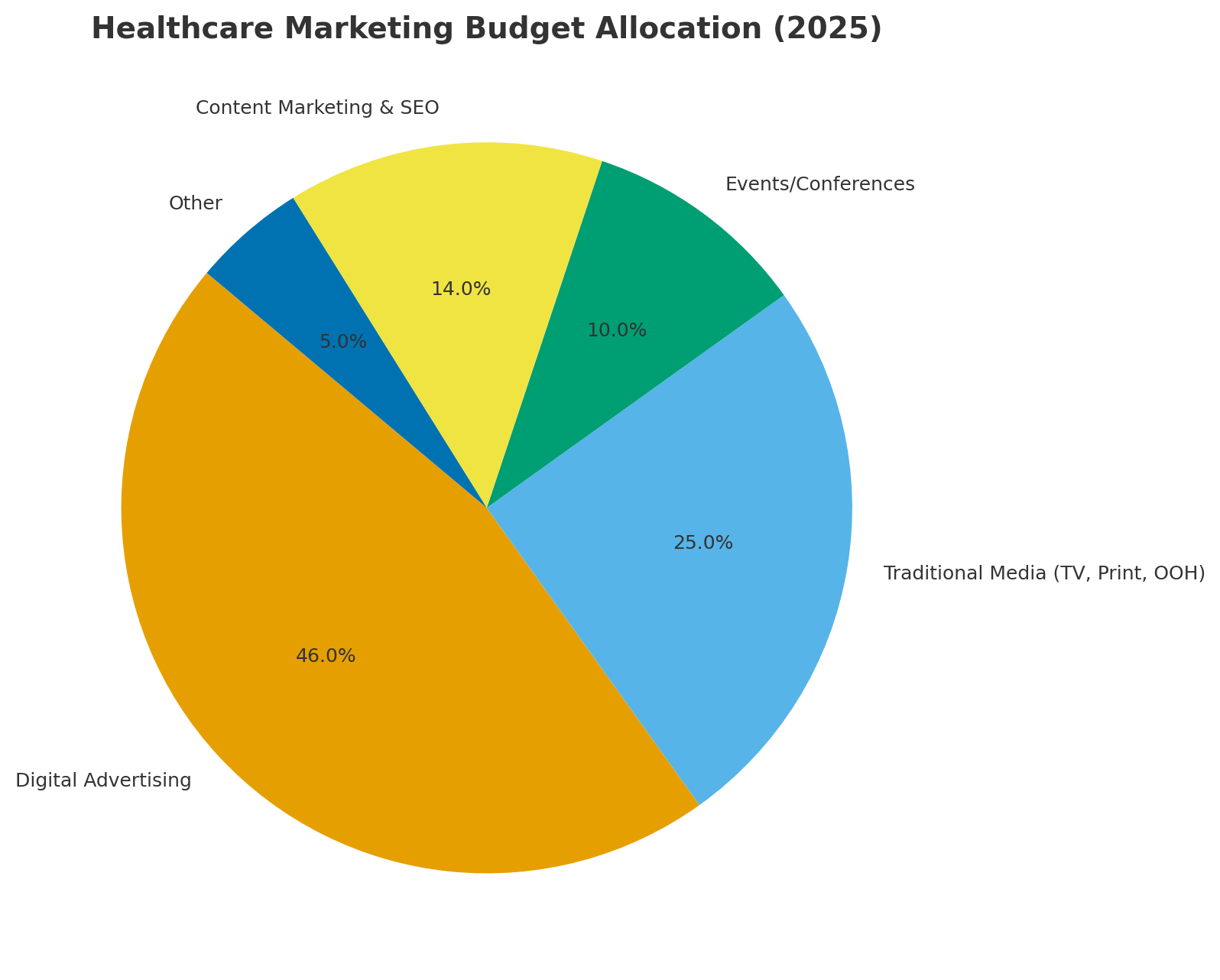
Section 3: Audience & Buyer Behavior Insights
Understanding the audience landscape is central to modern healthcare / MedTech marketing. In 2025, the line between “patient,” “clinician,” and “purchaser” continues to blur, but each audience still has distinct motivations, decision patterns, and data expectations.
3.1 Ideal Customer Profiles (ICPs)
These are health-seeking individuals looking for trustworthy information, affordability, and convenience.
They often begin their journey with search engines or social media, researching symptoms or treatment options before speaking to a provider.
Their biggest frustrations are information overload, inconsistent messaging, and unclear costs.
They respond best to transparent, empathetic storytelling and educational materials that make complex information digestible.
Decision drivers: reputation of the provider, cost transparency, ease of scheduling, and perceived quality of care.
Best channels: Google Search, YouTube, Facebook, and personalized email reminders.
Clinicians and specialists represent a technically informed but time-constrained audience.
They engage with content that adds clinical or operational value — such as peer case studies, journal-backed data, and new device evidence.
Their challenges include regulatory pressure, time scarcity, and integration barriers between technologies.
Marketing that wins their attention offers concise, data-driven insights, ideally endorsed by respected peers or medical associations.
Decision drivers: clinical proof, usability, and integration with existing workflows.
Best channels: LinkedIn, continuing-education webinars, trade journals, and professional newsletters.
These buyers are institutional decision-makers balancing budget efficiency, compliance, and reliability.
They oversee purchasing cycles for hospitals, group practices, or health systems, often evaluating multiple vendors simultaneously.
Their pain points revolve around ROI justification, interoperability, and vendor accountability.
They prioritize brands that provide measurable outcomes, lifecycle support, and compliance documentation.
Decision drivers: total cost of ownership, regulatory readiness, vendor track record, and post-sale support quality.
Best channels: LinkedIn, trade publications, RFP platforms, and in-person or virtual medical conferences.
This persona represents tech-savvy individuals using apps, wearables, and telehealth for wellness or preventive care.
They’re motivated by performance, personalization, and social validation.
Their main barriers are app fatigue, data privacy concerns, and interoperability gaps between platforms.
They respond to emotionally engaging, progress-oriented marketing that helps them visualize improvement over time.
Decision drivers: usability, data security, compatibility with other devices, and visible results.
Best channels: mobile app stores, influencer-led video reviews, podcasts, and community forums.
Insight:
Healthcare marketing can no longer rely on generic messaging. Segmentation by motivation and decision context enables personalised outreach: the “why” (health outcome) must match the “how” (digital journey).
Demographic Shifts
Psychographic Shifts
Implication:
Marketing messages must emphasize control, personalization, and trust. The patient/clinician relationship is being augmented by data transparency and experience design.
For patients and individual consumers, the path to care has become self-directed and multi-channel.
For clinicians, hospital administrators, and MedTech buyers, the path is more rational and evidence-driven.
Insight:
The clinician/buyer journey is longer and more data-driven, while the consumer journey is faster and emotionally influenced. Both require evidence and empathy, but via different tactics and channels.
Healthcare audiences in 2025 expect brands to treat their personal information with the same respect as their medical data. Privacy is now a purchase criterion, not an afterthought. A recent Harris Poll found that 81 % of patients want clear explanations of how their data is used before they share it. Organizations that communicate HIPAA and GDPR compliance transparently — with simple, reassuring language — gain trust and long-term retention.
At the same time, audiences demand personalization comparable to consumer tech experiences. They expect emails and ads that feel tailored to their conditions, preferences, and location. AI-driven segmentation and trigger-based journeys allow marketers to deliver this without sacrificing privacy. The goal is to make every interaction feel contextually relevant while remaining ethically compliant.
Finally, speed and responsiveness have become decisive. Nearly half of patients (48 %) say slow responses prevent them from booking appointments (Rock Health 2024). Real-time chat, instant appointment links, and AI assistants that triage inquiries bridge this gap. The faster a brand responds, the stronger the conversion and the greater the perceived trustworthiness.
Beyond functionality, patients and clinicians now want transparent, educational communication. They are wary of promotional claims and prefer evidence-based explanations supported by citations or expert endorsements. This shift toward factual storytelling is reshaping content strategy across the sector.
Strategic Takeaway:
The modern healthcare audience values clarity over complexity, personal relevance over generic messaging, and responsiveness over reach. Marketers who communicate with precision, compassion, and ethical transparency will set the standard for trust and growth in the 2025 MedTech era.
Persona Snapshot Table
Funnel Flow Diagram — Customer Journey (HTML SVG)

Here is a table showing typical channel performance in the healthcare/MedTech sector (CPC = cost per click, CVR = conversion rate, CAC = customer acquisition cost) along with comments. These are indicative benchmarks drawn from recent industry sources.
Stacked Bar Chart
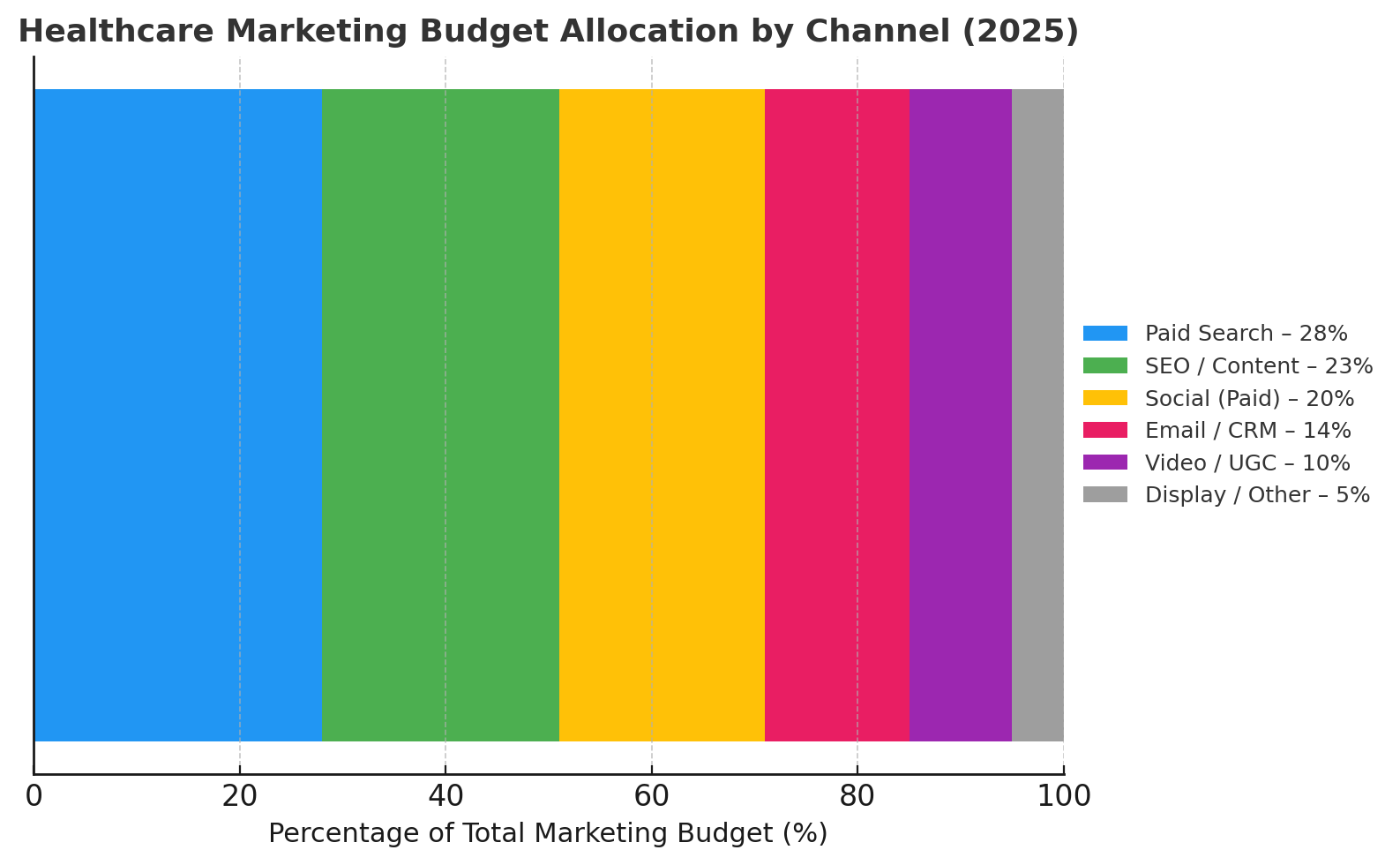
Implication: The technology stack for marketing in Healthcare/MedTech is rapidly growing — marketers must keep pace with tool adoption, integration, and data-platform maturity to compete effectively.
Gaining momentum
Under-leveraged or challenged
Toolscape Quadrant (Adoption vs Satisfaction)
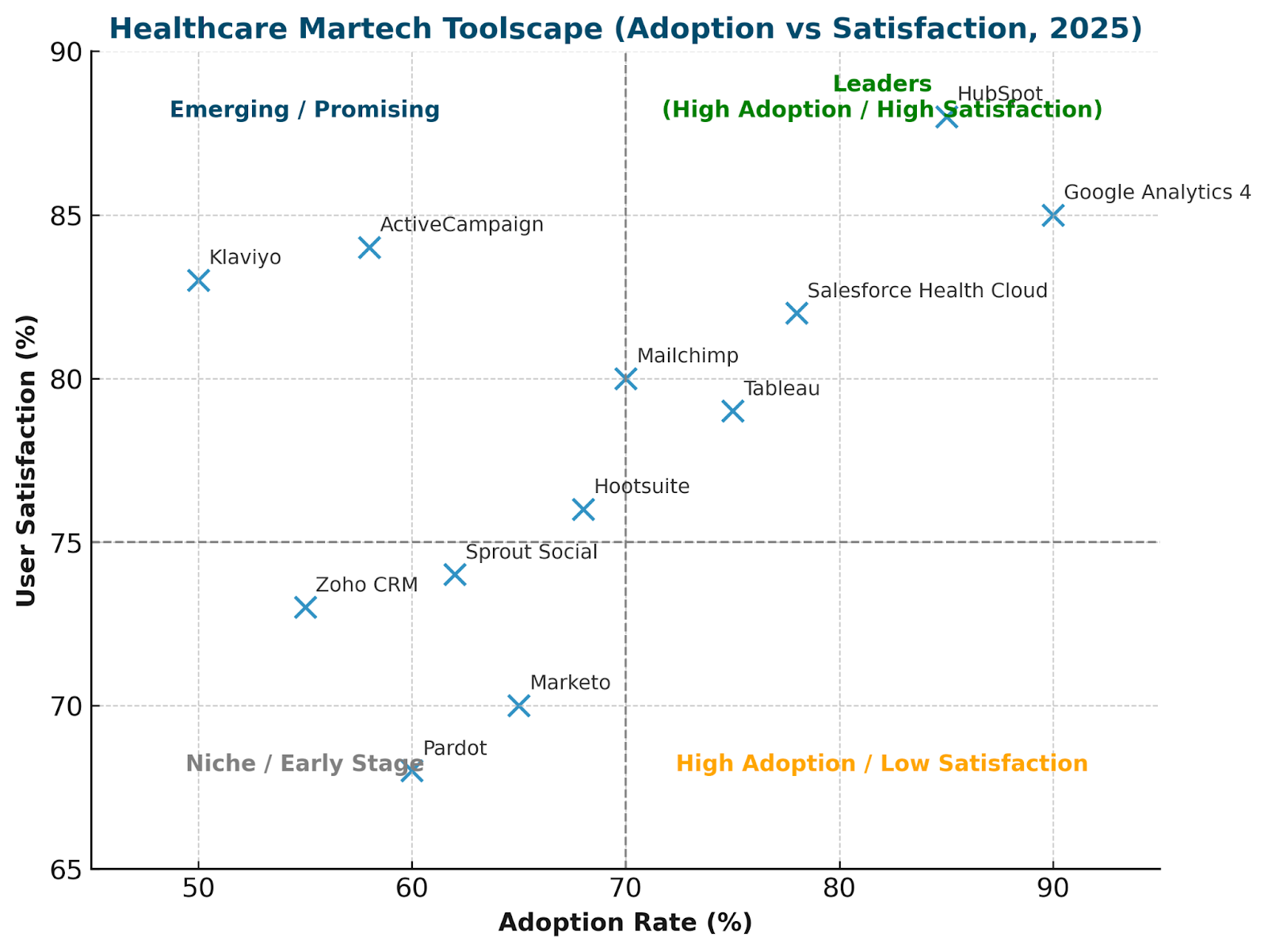
Suggested positioning for Healthcare/MedTech MarTech tools:
Healthcare and MedTech marketers are shifting from sterile, compliance-heavy creative toward human-centered storytelling and evidence-driven narratives. The winning formula blends credibility (facts, compliance) with empathy (human outcomes).
According to Hootsuite’s 2025 Healthcare Benchmarks, video and UGC (user-generated content) drive the highest engagement across platforms — 3.7 % on Instagram, 3.3 % on LinkedIn, and ~2 % on Facebook.
Short-form videos, carousels, and real-patient or clinician testimonials outperform static graphics by 60 – 90 % in CTR (Promodo 2024).
Instead of rigid templates, high-performing campaigns follow a clear emotional or informational logic:
Strategic takeaway: blend emotion + evidence. Every successful healthcare CTA contains either measurable outcomes or a personal story—never pure hype.
Creative performance has shifted decisively toward authentic, dynamic formats:
Strategic takeaway: adopt a “video-first, proof-driven” creative stack; prioritize authenticity over polish to satisfy both engagement and compliance.
Different healthcare segments respond to distinct emotional and informational triggers:
Strategic takeaway: map your creative tone to audience psychology—reassure providers, empower patients, inspire wellness users, and validate enterprise buyers.
Swipe-File collage
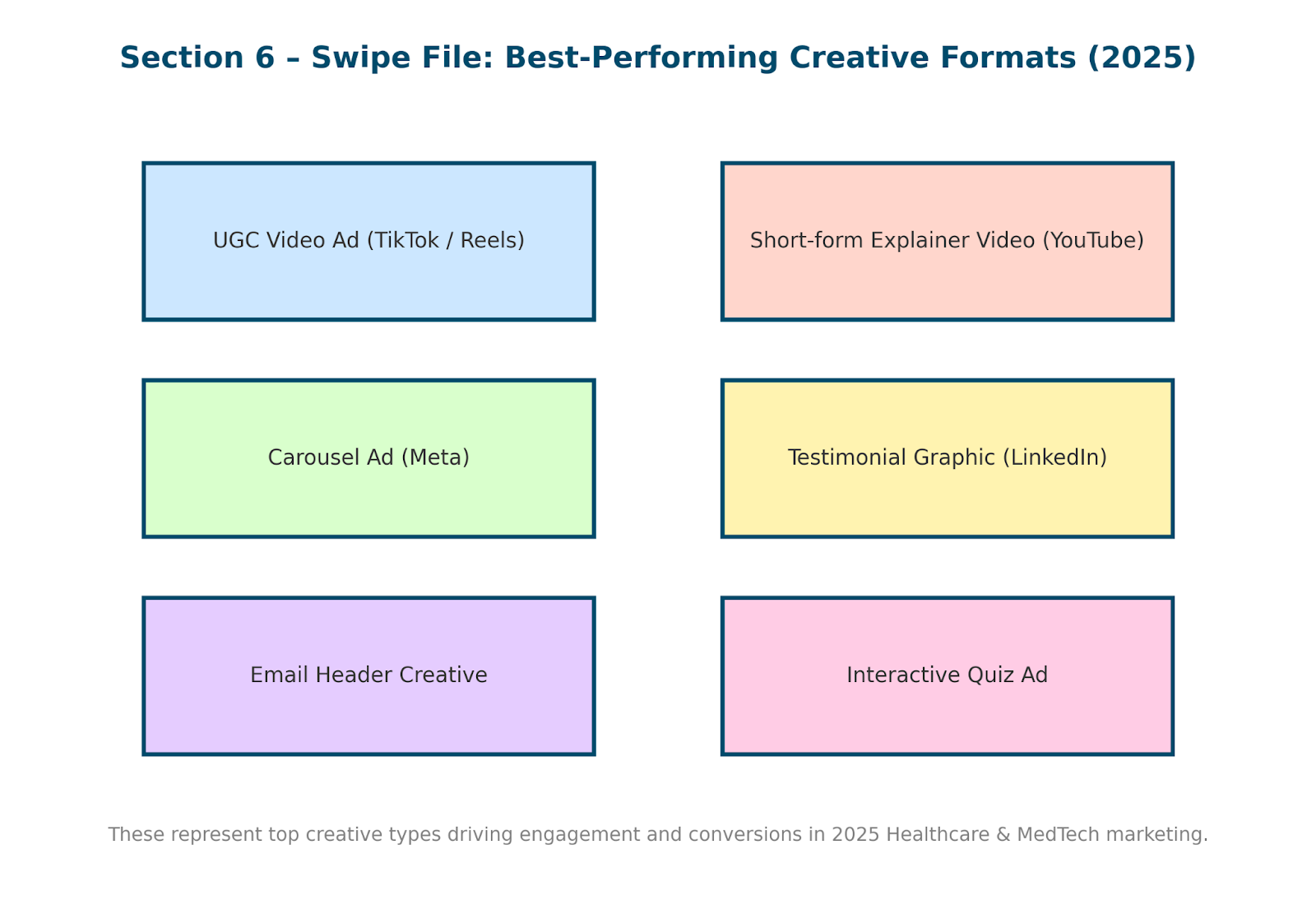
The most effective healthcare / MedTech campaigns of 2024-2025 balance evidence, empathy, and digital precision.
Across paid, owned, and social channels, these campaigns shared three winning traits:
Objective: Increase awareness of cardiovascular-screening services and motivate early testing.
Mayo Clinic launched a short-form-video series across Instagram Reels, YouTube Shorts, and LinkedIn, sharing real patient stories of recovery after heart procedures. Each 30-second clip opened with a human moment, closed with a clear CTA to “Book a free heart screening,” and was reinforced through an automated email reminder sequence.
Results:
Why It Worked: Emotional storytelling rooted in clinical truth. The creative balanced empathy with proof, and retargeting converted awareness into real appointments.
Objective: Educate and convert hospital buyers on a new AI-assisted surgical platform.
Medtronic built a thought-leadership funnel around the theme “Smart Surgery in Action.” It combined paid LinkedIn ads, precision Google Search campaigns, and a webinar series featuring key-opinion-leader surgeons demonstrating real outcomes. Leads captured via LinkedIn Forms entered a nurture sequence that linked to case studies and ROI calculators hosted in Salesforce Pardot.
Results:
Why It Worked: Authority and education replaced sales language. Peer credibility plus seamless CRM integration turned awareness into pipeline velocity.
Objective: Drive new app installs and boost retention for its virtual-care platform.
TeleDoc produced 15-second TikTok and Meta Story videos dramatizing instant virtual-doctor access under the tagline “Care without waiting rooms.” A retargeting layer reminded uninstalled users within 24 hours, while re-engagement emails showcased real-time physician availability.
Results:
Why It Worked: Speed and convenience matched post-pandemic expectations. Authentic, mobile-first creative and user-generated testimonials lifted trust and engagement simultaneously.
Campaign Card Template
8. Marketing KPIs & Benchmarks by Funnel Stage
Funnel Chart
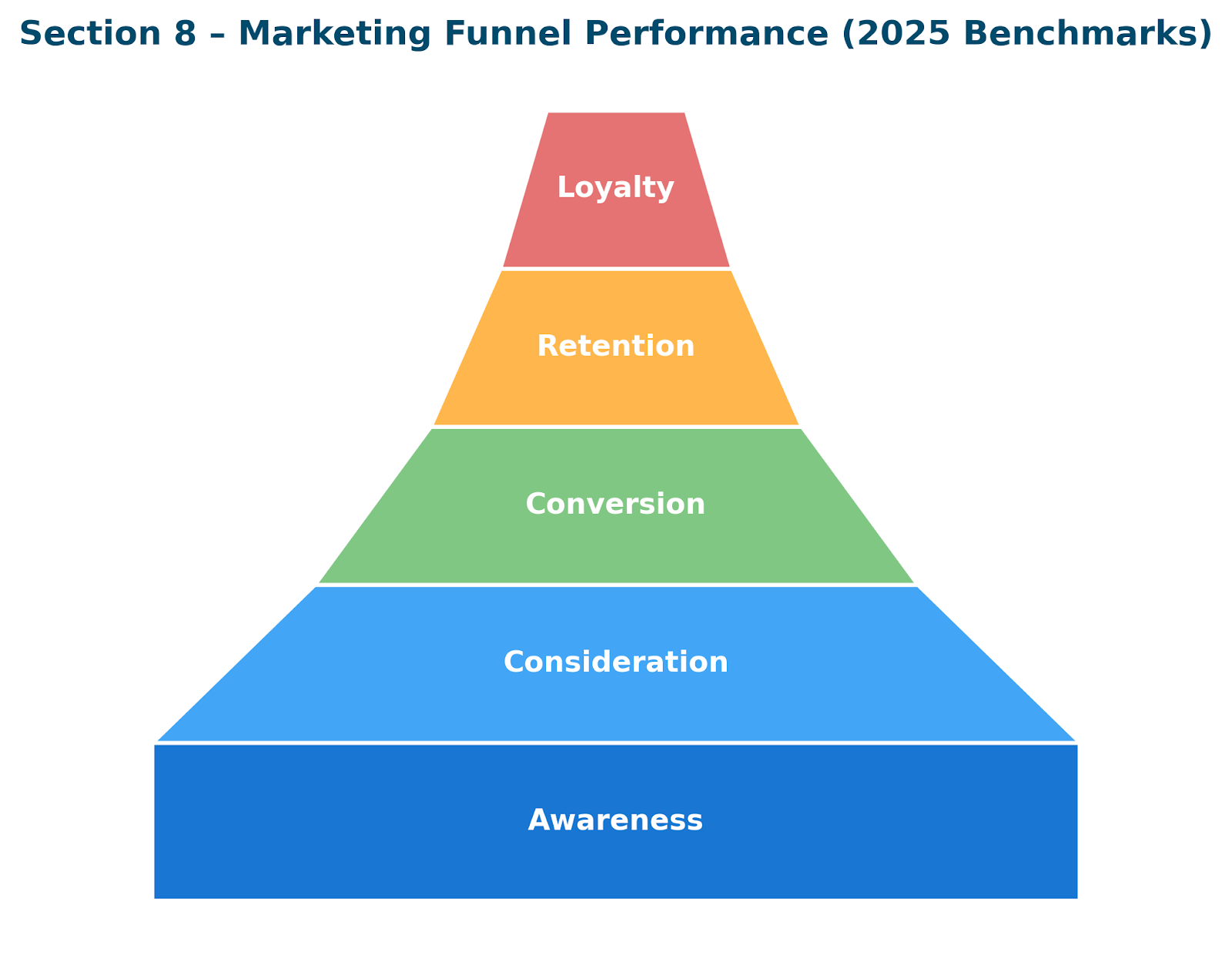
Healthcare and MedTech marketers face a paradox in 2025: rapidly advancing digital tools are expanding what’s possible, yet privacy laws, cost pressures, and channel saturation make execution harder than ever.
Success depends on balancing innovation with compliance and automation with authenticity.
Across all digital platforms, costs continue to surge.
Meta and LinkedIn CPMs are up about 18 % year-over-year, and healthcare search CPCs have climbed roughly 12 %.
This is driven by stricter privacy-based audience restrictions, greater competition for verified data segments, and reduced retargeting visibility.
The effect is unmistakable: customer-acquisition costs (CAC) are trending upward even as click volumes stagnate.
To counter this, marketers must lean on conversion-rate optimisation, long-tail keyword strategies, and higher-value creative rather than sheer spend.
The compliance landscape is tightening.
Updated HIPAA guidance, new U.S. state privacy laws, and stronger GDPR enforcement are limiting how health data can be tracked, stored, and used for marketing.
Cookie deprecation and consent-banner enforcement have sharply reduced available audience signals.
The risk is two-fold: first, potential fines or reputational damage; second, a measurable decline in personalization capability.
The strategic fix lies in building first-party data systems, consent-driven CDPs, and transparent user-value exchanges that earn data willingly rather than extract it passively.
Organic visibility is shrinking fast.
Healthcare brands now reach under 4 % of their social followers without paid support, as algorithms increasingly favor ad inventory.
Search results are dominated by ads, AI-summaries, and verified content hubs, crowding out smaller players.
The challenge is sustainability: brands cannot rely solely on paid amplification forever.
The opportunity is to invest in long-form educational content, community engagement, and SEO for AI-powered search (GEO: Generative Engine Optimization) to rebuild organic trust and discoverability.
Generative AI has entered nearly every marketing workflow—copywriting, design, and analytics—but accuracy and oversight lag behind.
While roughly 74 % of healthcare marketers report using AI tools, only about 37 % have a formal review process for factual verification or regulatory compliance (HubSpot AI Report 2025).
In an industry built on trust, unverified claims or hallucinated data can be disastrous.
Organizations need AI-governance frameworks: clear editorial review, medical validation checkpoints, and audit trails that preserve both compliance and credibility.
Risk/Opportunity Quadrant

The next phase of healthcare / MedTech marketing will reward precision, personalization, and regulatory discipline.
This section translates the trends and benchmarks from earlier sections into actionable strategy playbooks—tailored by organizational maturity: startup, growth, and scale.
Goal: build visibility and trust efficiently.
Core moves:
Goal: accelerate conversion & retention.
Core moves:
Goal: optimize LTV and brand authority.
Core moves:
As healthcare and MedTech marketing budgets evolve in 2025, spending is becoming more deliberate and performance-oriented. The trend is clear: marketers are moving money away from broad, low-ROI awareness buys and into channels that provide measurable outcomes, first-party data, and long-term relationship value.
SEO and Content Marketing remain the highest-priority investments. With the industry’s average ROI approaching 5×, organic traffic and thought-leadership content deliver compounding returns over time. Brands that consistently publish medically reviewed articles, clinical explainer videos, and case studies see sustained inbound lead generation without rising media costs. Content built for AI-summarised search (“Generative Engine Optimisation”) will also gain visibility as Google and Bing integrate generative results more deeply.
Paid Search continues to be indispensable for intent-driven acquisition. Though CPCs have risen about 12 % YoY, search remains the most efficient top-funnel engine because it captures existing need. Smart bidding, long-tail keywords, and geotargeting help offset cost inflation. Healthcare brands should maintain steady investment but continuously prune keywords for clinical accuracy and compliance.
Email and CRM Nurture Campaigns deserve higher budget share. They are the best retention channel in the sector, converting at roughly 4 – 5 % and delivering CACs under $ 40. Personalized drip campaigns, behavioral triggers, and predictive segmentation extend lifetime value and improve patient or customer satisfaction. Many organizations are reallocating 10 – 15 % of paid spend into CRM automations to improve retention economics.
Social Media Advertising—especially LinkedIn for B2B MedTech and Meta for consumer health—should hold a moderate budget position. CPMs and CPCs are climbing (+16 % YoY), but these channels remain vital for awareness, storytelling, and remarketing. Performance depends on fresh creative rotation and UGC-style authenticity rather than polished corporate visuals. Expect roughly 20 % of digital spend to stay here, primarily for brand building and retargeting.
Video and UGC Formats are now essential creative pillars. Short-form video (< 30 s) achieves ~60 % higher CTR than static ads, while clinician or patient-generated clips outperform branded content. Budgets should expand modestly in 2025 – 2026 to produce ongoing streams of authentic, compliant visual storytelling.
Events and Webinars continue to deliver value in B2B and clinical education contexts. Though not as scalable as digital ads, these experiences deepen trust and accelerate enterprise sales cycles. Marketers should integrate them with digital nurturing, using webinars as mid-funnel assets that feed email and retargeting pipelines.
Finally, Display and Traditional Media will continue their gradual decline in relevance. With CPMs high and click-through rates below 0.6 %, these channels function primarily for awareness lift and frequency control. Combined allocation across display, print, and broadcast should stay below 10 % of the total marketing budget unless brand equity building is a top strategic goal.
In summary:
Investment priority ranks as follows — SEO / Content (High), Paid Search (High), Email / CRM (High), Social and Video (Medium), Events (Medium), and Display / Traditional (Low). The guiding principle for 2025 – 2026 is to optimize for owned data and measurable ROI, not channel novelty.
3x3 Strategy Matrix
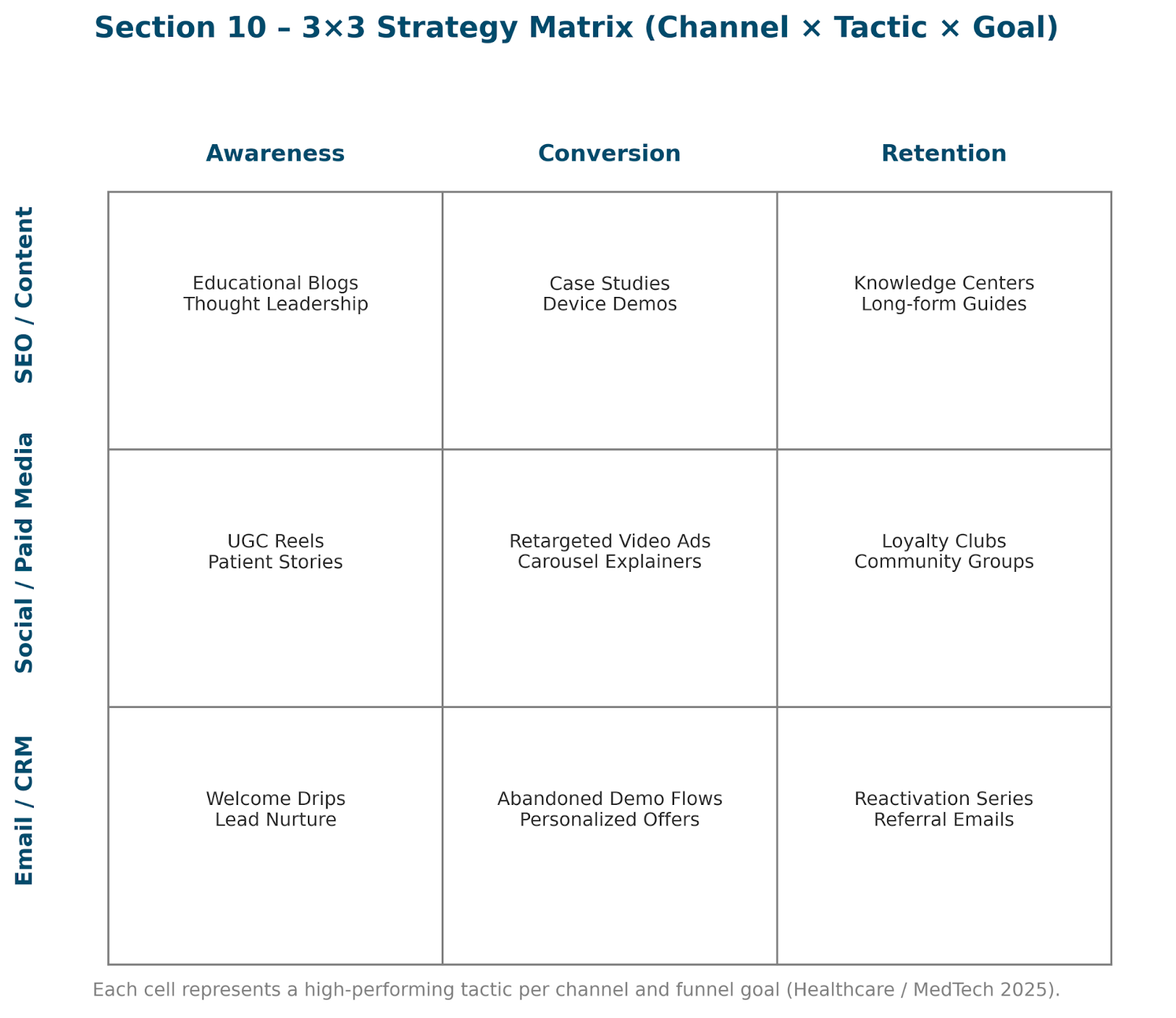
1. Ad Budgets & Channel Mix
2. AI Adoption & Tooling
3. Platform Dominance & Shift
4. Regulatory & Data Landscape
5. Creative Evolution
“We’re seeing a phase-shift from reach to relevance in healthcare marketing. The winners will be those that treat data privacy as a design principle and not a constraint.”
— Maria Chen, CMO at MedTech Analytics, Health Marketing Review 2025
“Generative AI won’t replace creative teams—it will amplify them. In regulated sectors like MedTech, accuracy auditing will define brand credibility.”
— Dr. Alan Martens, AI Ethics Researcher, Stanford Digital Health Lab
The return-on-investment outlook across healthcare and MedTech marketing channels continues to shift as privacy regulation, automation, and creative innovation reshape cost efficiency.
The next two years will reward channels that combine first-party data, automation, and educational storytelling.
Email and CRM Automation will remain the single most profitable investment.
After years of consistent performance, email is forecast to deliver an ROI rising from 3.8× in 2024 to around 4.5× by 2026, as improved segmentation and AI-driven send-time optimization increase engagement.
Healthcare audiences still respond to personalized reminders, patient-journey emails, and outcomes-based follow-ups, making this the lowest-cost, highest-impact retention lever.
Paid Search should maintain strong efficiency despite rising costs.
ROI is projected to grow modestly—from 3.1× to roughly 3.6×—as automation improves targeting precision and reduces wasted impressions.
While CPC inflation (≈ +12 % YoY) pressures budgets, intent-based queries for specific treatments or devices remain unmatched for lead quality.
SEO and Content Marketing continue to dominate long-term value creation.
With compounding visibility and zero marginal cost per click, expected ROI climbs from 4.5× (2024) to above 5.3× by 2026.
Brands investing in medically reviewed blogs, clinician explainers, and AI-optimized site architecture will outperform peers as generative-search engines favor authoritative content.
Social Media (Paid), by contrast, will see gradual erosion in efficiency.
ROI is forecast to dip from 2.4× to ~2.1× through 2026 as CPMs rise and algorithms reduce organic reach.
Nevertheless, social remains indispensable for awareness, retargeting, and user-generated storytelling—particularly when paired with short-form video assets.
Video and UGC (Short-Form Content) are breakout performers.
ROI should increase sharply—from 3.7× to around 4.8× by 2026, making it the fastest-growing creative format.
Authentic, mobile-first content featuring patients or clinicians boosts engagement and trust while reducing production cost relative to traditional broadcast.
Finally, Events and Webinars are regaining traction in B2B MedTech marketing.
Projected ROI rises modestly—from 2.9× to 3.4×, driven by hybrid event formats and integrated post-event nurturing workflows.
These channels excel at deepening relationships with decision-makers and converting mid-funnel prospects into qualified leads.
In summary:
By 2027, the healthcare marketing ROI hierarchy will rank roughly as follows:
1️⃣ SEO / Content → ≈ 5× return;
2️⃣ Email / CRM → ≈ 4.5×;
3️⃣ Video / UGC → ≈ 4.8×;
4️⃣ Paid Search → ≈ 3.6×;
5️⃣ Events → ≈ 3.4×;
6️⃣ Social (Paid) → ≈ 2×.
The clear pattern is convergence on owned and trust-based channels delivering stable, privacy-safe growth, while high-cost paid social continues its slow decline in efficiency.
Line Graph: Expected Channel ROI Over Time

Innovation Curve for the Sector

Data Collection & Analysis
This report combines quantitative data (industry benchmarks, ad-spend forecasts, engagement statistics) and qualitative analysis (expert commentary, case studies, and marketing-trend synthesis).
Analytical Approach
Industry Research & Reports
Creative & Campaign Performance Sources
CRM / MarTech Stack References

Digital marketing dashboards are cluttered with metrics that look impressive—until you try to tie them to actual revenue.
And in B2B, where sales cycles are long, buyers are scarce, and deal values are high, chasing vanity metrics isn’t just unhelpful—it’s dangerous.
B2B marketers aren’t just selling to one person with a credit card.
They’re selling to committees, procurement teams, and decision-makers who read whitepapers in their spare time.
That means every digital marketing activity needs to be laser-focused on generating pipeline and accelerating deals—not just getting eyeballs.
This post cuts through the noise to spotlight the B2B digital marketing metrics that actually matter—the ones that drive pipeline and reveal digital marketing’s true ROI.
Whether you're in IT/software/SaaS, enterprise services, or complex consulting, these are the KPIs you should care about if you're serious about scaling your marketing strategy.
Forget the fluff. Let’s focus on what really moves the needle.
Most B2B marketers are drowning in data—and still can't prove ROI.
Here’s what you should be tracking within your org if you want to drive real pipeline and revenue:
Scrub out the vanity. Track what moves deals forward.
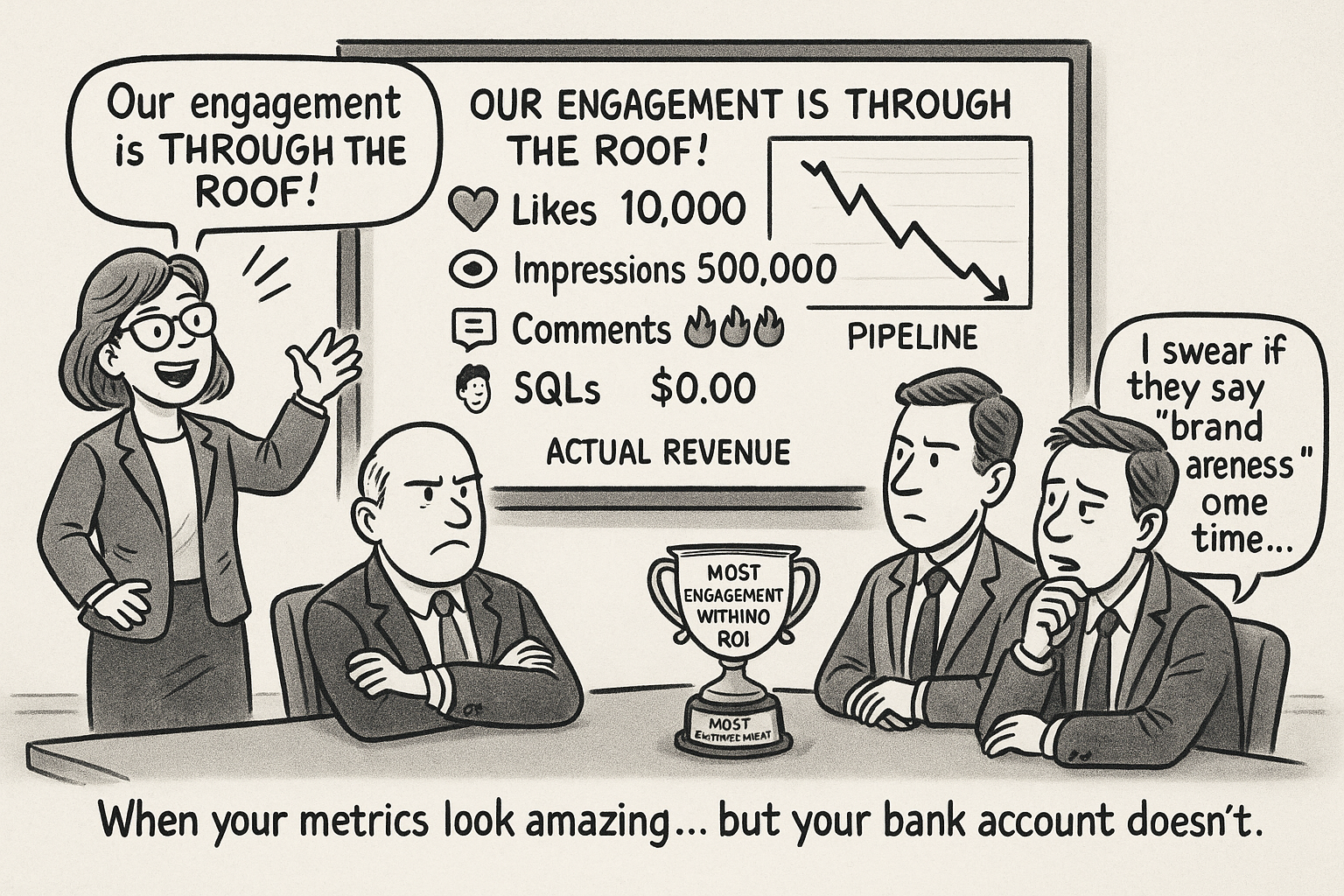
It's a blunt truth: most digital marketing dashboards are stuffed with junk metrics.
Sure, your last LinkedIn post got 1,000 impressions.
Your email had a 35% open rate.
Your blog traffic doubled last month.
But here's the real question: Did any of that generate sales pipeline?
In B2B, where sales cycles are long and buyers rarely impulse-purchase enterprise software, vanity metrics are dangerous.
Vanity metrics help marketers feel busy.
They look great in slide decks.
But they often have zero correlation with revenue.
Here are a few usual suspects:
Vanity metrics distract marketers from the real goal: generating and accelerating revenue.
Worse, they can create a false sense of success that leads to bloated budgets, misallocated resources, and misaligned marketing-sales relationships.
You’re not in B2C.
This isn’t about volume—it’s about precision.
You should be using a rifle and not a shotgun.
One CMO at your target account is worth more than 10,000 anonymous clicks.
It’s time to stop measuring noise and start measuring impact.
Not all metrics are created equal—and they shouldn’t be treated the same at every stage of your B2B marketing funnel.
The metrics that matter at the top of the funnel aren’t the same ones that matter when your sales team is chasing signatures.
Here’s how to separate signal from noise, based on where your prospect is in their buyer journey:
At this stage, your goal is visibility with the right audience—not just anyone with a browser. You’re planting seeds.
This is where curiosity turns into consideration. You need to know who’s leaning in.
Now it’s all about revenue. Time to get ruthless with your metrics.
By aligning your metrics to your funnel stages, you create clarity—not just for marketing, but for sales, leadership, and your P&L. If your dashboard doesn’t tell you where leads are stalling or accelerating, it’s time to rewire it.
If your team is running account-based marketing (ABM)—whether light-touch or fully orchestrated—you can’t rely on lead volume alone. Traditional funnel metrics don’t tell the full story when you’re targeting a narrow list of high-value accounts with personalized content and multi-channel outreach.
ABM success lives and dies on engagement from the right people at the right companies. Here’s what actually matters:
You can’t land a six-figure deal by only talking to an intern.
ABM isn’t about more leads. It’s about deeper relationships with fewer accounts.
These metrics help you monitor that depth—and make sure your marketing dollars are generating traction where it counts.
Let’s be real: your C-suite doesn’t care how many likes you got on LinkedIn or how many people opened last Tuesday’s newsletter. They care about pipeline. They care about efficiency. They care about revenue.
If you want marketing to sit at the grown-up table, these are the metrics that matter most:
High CAC = unscalable growth. Get it under control.
LTV tells you what a customer is worth. CAC tells you what they cost.
If your reports don’t include these numbers—or can’t explain how your SEO, ads, and content map back to them—you’re not doing marketing. You’re doing theater.
In an ideal world, a lead would click your ad, fill out a form, take a demo, and sign the contract—all while perfectly tracked in your CRM.
In the real world? They read a blog post six months ago, heard your CEO on a podcast, saw a LinkedIn ad, checked out three competitor sites, ignored five emails, Googled your brand name, and then converted.
Good luck attributing that to one “channel.”
Relying on single-touch attribution in B2B is like giving credit for a touchdown to the person who handed the ball off at the 1-yard line.
Marketing attribution in B2B isn’t about perfection. It’s about creating enough visibility to make smarter decisions. When in doubt, ask your closed-won customers: “How did you first hear about us?” Their answers might surprise you—and they won’t be in your CRM.
Each marketing channel has its own behavior, benchmarks, and BS. One-size-fits-all metrics are a fast way to waste money—or worse, misinterpret what’s actually working.
Below are the metrics that matter most, channel by channel:
SEO is a slow burn—track long-term ROI, not just rankings.
High CTR with low conversion = clickbait. Don’t confuse curiosity with intent.
LinkedIn is expensive—but powerful when hyper-targeted.
One strong reply from the right buyer beats 10,000 opens from randoms.
If nobody follows up after your webinar, did it really happen?
You’re borrowing someone else’s audience—make the most of it.
Most marketing dashboards are either a bloated mess of meaningless metrics or a barren wasteland with one lonely CTR stat. Neither tells a useful story. If your dashboard doesn’t help you make decisions, it’s not a dashboard—it’s decoration.
Here’s how to build a reporting system that actually helps you win:
Stop reporting on what you did. Start reporting on what it did for the business.
❌ “We published 8 blog posts and ran 4 webinars.”
✅ “Our blog generated 14 MQLs and influenced $72K in pipeline. Webinars sourced 2 SQLs and accelerated 1 deal.”
One dashboard does not fit all. Tailor the data to the decision-maker.
Your dashboard should work harder than your marketing intern. If it doesn’t, rebuild it.
Dashboards don’t create value. Your interpretation of them does.
Every dashboard should have a takeaway:
It turns data from static to strategic.
It’s one thing to measure what’s happening—it’s another to ensure that what’s happening actually supports your business objectives. That’s where most marketers drop the ball.
Marketing metrics without strategic alignment are just noise. Your KPIs should directly map to the things that matter most to your organization: growth, efficiency, pipeline velocity, and profitability.
Every marketing activity should support a strategic goal:
If a metric doesn't help you achieve one of these, it belongs in a marketing trivia night—not your dashboard.
Saying your CPL is $150 is meaningless unless you know that:
Benchmarking brings clarity—and helps you justify budget increases or reallocations.
Marketing doesn't exist in a vacuum. Strategy should evolve with data—and data should be shaped by strategy.
Good metrics don’t just inform—they provoke action.
Metrics should guide your next move—not just explain the last one.
When strategy and metrics are in sync, your marketing isn’t just reporting performance—it’s driving it.
Even experienced B2B marketers fall into traps when it comes to tracking (and presenting) marketing metrics. The tools make it easy to measure everything—but that’s exactly the problem.
Here are some of the most common mistakes that quietly kill marketing performance, trust, and budget:
When everything is important, nothing is. Bloated dashboards confuse stakeholders and bury insights. Focus on the few KPIs that actually move revenue, not a buffet of meaningless data.
❌ “We track 67 KPIs.”
✅ “We track 7 that tell us where to invest next month.”
Your execs don’t care how many blog posts you wrote or emails you sent. They care about what those activities delivered in terms of leads, pipeline, and revenue.
Stop saying: “We ran 3 webinars.”
Start saying: “Our webinars generated 14 SQLs and $40K in influenced pipeline.”
If your leads look good on paper but your sales team thinks they’re junk, your metrics are lying to you. Closed-loop reporting with sales is non-negotiable.
Your best metric? Sales actually wants to call your leads.
Averages lie. Segment by channel, buyer persona, industry, funnel stage—whatever gives you clarity. One superstar campaign can mask five that are quietly wasting budget.
Just because something is easy to measure doesn’t mean it matters. Impressions, likes, and open rates don’t pay the bills unless they correlate to pipeline or revenue.
Marketing theater is not marketing strategy.
A $200 CPL might be fine—unless last quarter it was $120. Without historical benchmarks, you can’t spot trends, diagnose problems, or make confident strategic moves.
Tools are built to be flexible, but many teams default to whatever their CRM or ad platform surfaces by default. That’s lazy.
Define your strategy first, then bend the tools to fit it—not the other way around.
Mistakes in metric strategy aren’t just embarrassing—they’re expensive. They mislead teams, misalign departments, and can cost your marketing team credibility when it matters most.
B2B marketing isn’t about looking busy—it’s about driving pipeline, shortening sales cycles, and fueling revenue growth.
The right metrics tell you what’s working, what’s not, and where to go next.
The wrong ones?
They just make your dashboard look pretty.
So here’s the bottom line: measure what matters.
Ignore the noise.
Ditch the vanity.
Build a measurement framework that’s grounded in real business outcomes, not just digital activity.
Align it to strategy, clean up the clutter, and get buy-in from sales and leadership.
Your metrics should be a compass—guiding your decisions, validating your experiments, and charting a path toward scalable growth.
But they should never be a crutch that excuses bad performance or hides behind high click-through rates.
Because at the end of the day, likes don’t pay invoices.
Pipeline does.

AI is the new duct tape (errr...slippery snake oil) of digital marketing—everyone’s slapping it on everything and hoping it holds.
Headlines scream about how ChatGPT will “replace marketers,” while pitch decks now feature “AI-powered” somewhere between “scalable” and “disruptive.”
It's beyond "bubble" and "hype" at this point.
But here’s the hard truth: If your strategy is broken, adding AI won’t fix it. It’ll just break faster and at scale.
AI can’t solve foundational strategy problems.
We'll show you with some real AI marketing faceplants, and explain how smart brands use AI as an amplifier—not a bandage.
TL;DR:AI is a tool, not a strategy. If your marketing plan is weak, AI won’t save you—it’ll just help you fail faster and louder--ultimately hurting your brand image more. Here we unpack why relying on generative AI tools without solid positioning, market segmentation, or clear campaign goals is a recipe for scale-without-sense.
Learn how to stop AI prompting in circles, siloes and echo-chambers and start building a digital marketing strategy worth automating and scaling.
There’s a temptation to believe that if you plug an LLM (large language model) into your marketing machine, all your problems will magically evaporate.
Take the now-infamous Willy Wonka Experience debacle.
The event was marketed with fantastical AI-generated visuals—think candy castles and golden chocolate rivers.
Reality?
A sad warehouse, confused kids, and a viral disaster.
When you market vapor with AI, don’t be surprised when the backlash is real.
Lesson: If your product is broken or non-existent, no amount of AI glitter will make it gold.
Think of AI as a megaphone.
It doesn’t change your voice; it just makes it louder.
So if you’re yelling nonsense, you’ll just annoy more people, faster.
Example: Coca-Cola’s AI Christmas Campaign.
The visuals were slick, but critics found the ads emotionally cold—like they were dipped in uncanny valley eggnog.
When a brand built on warmth and nostalgia replaces humans with AI-generated “joy,” the dissonance is deafening.
Using AI to scale outbound or content production before understanding your audience is like speeding toward a destination without checking the map.
A real-world case: A link building agency focused on B2B used AI to pump out hundreds pages—without ever validating product-market fit and assuming search engines wouldn't take notice.
Result? Crickets. No sign-ups, no replies, just a whole lot of burned budget and SEO clutter.
Snark aside: ChatGPT can’t tell you if your product sucks. Only customers can.
Then there’s the awkward case of Levi’s AI-generated models. Instead of hiring real models of diverse backgrounds, the brand used synthetic avatars.
The internet trolls were not impressed.
Critics accused them of sidestepping real representation in favor of digital optics.
Takeaway: When the goal is authenticity, generating fake people probably isn’t the best look.
Let’s not forget what AI learns from: data.
If your data is biased, incomplete, or just plain wrong, the outputs will mirror that.
Amazon’s AI recruiting tool famously penalized resumes that included “women’s” (e.g., “women’s chess club”) because historical data reflected gender bias. Amazon scrapped the system. Imagine unleashing that kind of bias on your PPC campaigns or creative strategy.
Yikes.
“We’ve added an AI co-pilot!” Great. For what? A pilot still needs a flight plan.
Many companies use AI as a buzzword placeholder for actual strategic thinking.
Google’s Gemini image generation fail is a case in point—offensive historical inaccuracies, hallucinated data, and a Super Bowl ad that had to be edited after the fact.
Reality check: AI needs constraints, context, and clarity.
Strategy is what gives it all three.
AI is powerful—but only in the hands of marketers who already know where they’re going.
Think of it like a Formula 1 engine: if your team doesn’t understand race strategy, track conditions, or when to pit, adding horsepower only guarantees a faster crash.
However, when paired with sound strategy, AI can be a force multiplier:
Start by mapping your customer journey and identifying what messaging belongs at each stage—from awareness to conversion to retention.
Then, use AI to atomize long-form content into smaller pieces: blog posts into tweets, podcasts into blog summaries, case studies into LinkedIn posts.
But don’t confuse motion for momentum.
Without knowing why the content exists and who it's for, you’re just making noise faster.
AI can deliver personalization at scale—but only if you’ve defined your audience segments, customer personas, and behavioral triggers.
If you skip the foundational segmentation work, your “personalized” messages will just be algorithmic guesswork.
They will also come across as extremely fake.
With the right audience understanding, though, AI can fine-tune tone, timing, and offers across channels.
AI excels at rapid iteration and optimization, but it needs boundaries.
Set clear KPIs like ROAS or CAC, and define your acceptable risk tolerance.
With a real digital marketing strategy in place, AI becomes a smart assistant for A/B testing creative, allocating budget dynamically, and improving performance with less manual tinkering.
AI can crunch data far better than most human analysts.
But if you haven’t defined which metrics matter (and which ones don’t), you’ll just end up with dashboards full of noise.
Strategy determines which questions to ask.
AI helps answer them faster—whether it's forecasting churn, identifying anomalies, or surfacing patterns in customer behavior.
AI can generate dozens of ad copy variants or landing page designs in seconds.
But velocity without intention leads to waste.
Build a testing roadmap.
Define hypotheses, testing windows, and evaluation criteria—then let AI do the heavy lifting within that strategic sandbox.
Guardrails make experimentation efficient instead of chaotic.
Here's an example of an internal testing roadmap for your next digital marketing campaign:
AI is not a strategist.
It doesn’t know your goals, your brand, or your customer’s emotional drivers.
That’s your job.
What it can do is execute your strategy faster, scale your experiments, and surface insights you may have missed.
But the thinking—the decisions about where to go and why—still requires a human mind.
Preferably one that doesn’t outsource its job to an autocomplete model.
In other words: AI helps you move faster—but only if you’re pointed in the right direction.
If your business is adrift, AI will get you to the iceberg faster.
The marketing world doesn’t need more gimmicks—it needs better strategy.
The smartest brands in the AI age aren’t just asking “What can this tool do?” They’re asking:
“What do our customers actually need—and how can we use AI to deliver it better?”
And how can we do it with authenticity?
One of the biggest brand risks with using AI is tarnishing a reputation based on creating copy and creative that comes across as inauthentic. This is one of the biggest risks AI presents to your corporate brand.
But AI is admittedly getting better at strategy, which means marketers' jobs are still at risk of oblivion to the AI overlords.
Just because AI isn't as good at strategy now, doesn't mean it won't be able to beat you in the not-so-distant future.
Need help crafting a real strategy—one that AI can actually enhance?
Let’s talk. At MARKETER, we help brands build digital marketing plans worth automating at scale.

.svg)