Ah yes, it’s that time again. You log in to check your site metrics and—boom—your traffic graph looks like it fell off a cliff. SEO forums are in meltdown, X.com is ablaze with speculation, and somewhere, a Google engineer is sipping tea and watching it all unfold.
Welcome to another round of “What fresh hell hath the algorithm wrought?”
For SEOs and digital marketers, Google updates are less like helpful notifications from a benevolent overlord and more like jump scares in a horror movie.
We know they’re coming.
We know.
But we’re never truly ready.
Let’s talk about why these updates send the marketing world into collective hysteria—and why maybe, just maybe, it’s time to stop panicking and start adapting.
Google releases hundreds of algorithm tweaks every year.
But it’s those few labeled “Core Updates” that make grown SEO professionals cry into their keyword trackers.
Why?
Because we don’t know what they’re targeting. Google’s messaging is as clear as mud:
“We’re improving search to better help users find useful content.”
Useful. Right.
Like that “top 10 pasta recipes” site ranking for your SaaS software brand name.
As other industry prognosticators have so eloquently put it: "It's more like an unhelpful content demotion, than a helpful content update."
And anytime an update is labeled as spam, you never know if lurking shadow backlinks may be there to cause you harm.
Meanwhile, rankings tank, traffic flatlines, and clients start asking questions like “Have you tried… just submitting it to Google again?”
It also doesn't help that when webmasters weigh the 50/50 chance of help vs. hurt in Google Algorithm Updates, they typically lean into their fears, many of which have been recently justified by drops like:

Here’s the typical monthly algorithm soap opera:
Meanwhile, your inbox is full of subject lines like:
“HELP! My keywords are dying.”
Let’s give them some credit. Google isn’t (just) trying to ruin your month. They're aiming to:
And let’s be honest: they’re also trying to keep more traffic on Google itself. That zero-click search life is very real.
What gets my blood boiling even more is the terrible user experience (UX) of seeing click ads interspersed between every other organic result:
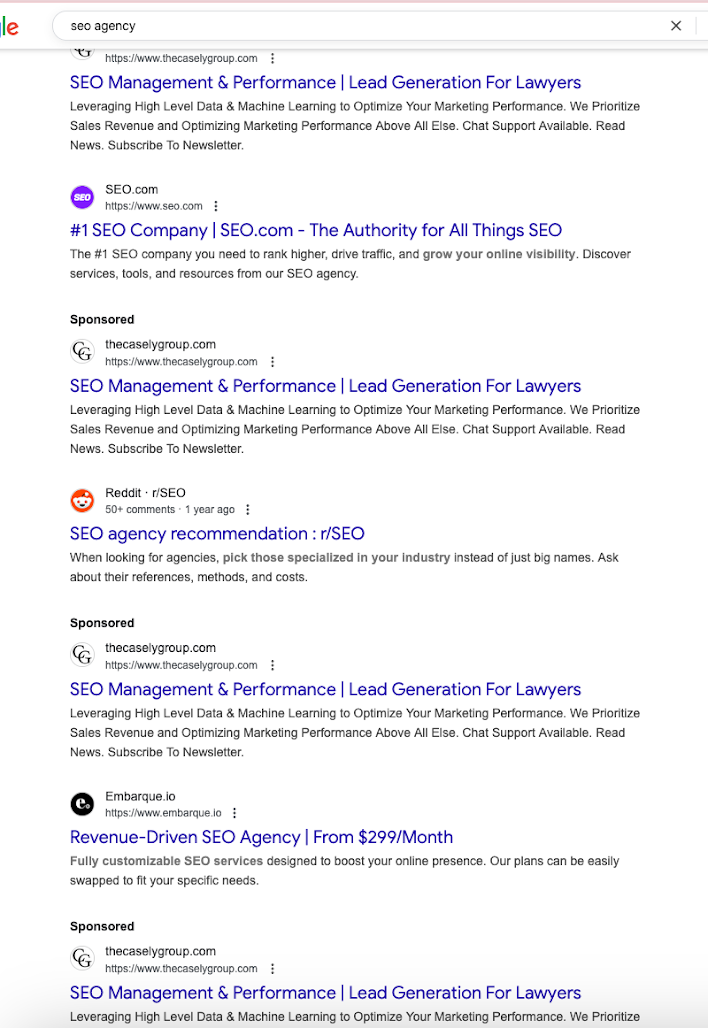
How is seeing the same ad five times in the first page of results a "helpful" user experience?
What Google is actually working to do is maximize revenue for shareholders.
They own the platform and the power of being a winner-take-all market leader is that you can ruin the search experience and still not be fully punished.
We publishers wish we welding at least some of that power, but alas.
It’s easy to joke about algorithm updates when you're managing enterprise sites with deep pockets, massive content teams, and a safety net made of paid traffic. But for small and mid-sized businesses (SMBs), Google updates can feel like a digital guillotine.
These businesses aren’t just chasing vanity rankings—they rely on organic traffic to drive actual sales, leads, phone calls, and foot traffic. And when a broad core update drops out of nowhere and shuffles the search deck, some of them fall completely off the map.
We’ve seen it:
These aren’t hypothetical. These are the real, painful consequences of being over-leveraged on organic search.
And if you run a digital agency as one of our own white label digital marketing partners, your reporting dashboard becomes a weapon your clients use against you.
We have sadly seen the results of tarnished websites that never appear to recover from their "glory days," only to wait around for months
Even worse? SMBs often don’t have the resources to recover quickly.
They don’t have an in-house SEO team.
They can’t just spin up a $10K/month paid search campaign to fill the gap.
They're stuck scrambling—Googling SEO guides, calling up their nephew who “knows computers,” or firing their agency without realizing the update wasn’t their fault to begin with.
When your entire funnel depends on being visible in local and organic search, a Google update isn’t just an inconvenience.
It’s an existential threat.
Here’s the good news: panicking won’t help, but preparation will. Here’s how to keep your head:
Focus on fundamentals: E-E-A-T, page experience, crawlability. The stuff Google keeps screaming about.
Diversify traffic: If 90% of your traffic is organic, you’re living dangerously. Get some email, paid, and referral love.
Communicate with clients: Set expectations early and often. "SEO is a long game" is your new mantra.
Use data, not vibes: Traffic is down? Check GSC, GA4, and actual rankings. Don’t make decisions based on one keyword and a gut feeling.
Diversify your content strategy: This can mean several things including 1) using video, YouTube, TikTok; 2) having a multi-domain strategy to ensure the latest updates don't hit a single website 3) use paid search management to smooth out the rocky bumps in organic traffic.
Now before you rage-quit SEO and start a goat farm in rural Vermont, hear us out: not all Google updates are evil.
In fact, some of them are... good. (We know—wild concept.)
While Google algorithm updates can absolutely feel like a digital punch to the gut, they also serve a purpose: to clean up the garbage and reward sites that are actually helpful, trustworthy, and user-focused.
If your competitors were gaming the system—stuffing keywords, buying shady links, or spinning mass quantities of AI content like a blender full of gibberish—there’s a decent chance they just got torched.
That’s your opportunity.
We’ve seen sites that:
In other words, Google updates can be the great equalizer—especially if you’ve been playing the long game.
They shake up the stale, reward the real, and offer a window for ethical SEOs and well-managed websites to rise. If your site survives and even improves after an update, that’s not luck—it’s a sign your foundation is solid.
And if you did take a hit, but you're not doing anything shady? Great. You now have a reason to re-evaluate, refresh, and level up your site quality. That’s not a punishment—it’s a growth plan in disguise.
Here’s a wild idea: sometimes the panic is actually an opportunity.
Let’s be clear: not all freak-outs are created equal. You should worry if:
Otherwise, take a breath and chill and continue to practice the fundamentals.
At the end of the day, SEO is a game of endurance. Google updates will keep coming. The rules will keep changing. And marketers will keep Googling “Why did my traffic drop overnight.”
The trick isn’t to avoid the panic. It’s to expect it—and outlast it.
If you’re tired of white-knuckling your way through every update, maybe it’s time to bring in some help.
At Marketer.co, we build SEO campaigns that don’t just survive updates—they’re built to thrive in spite of them.
Let’s turn your monthly panic into a long-term plan.
Contact us before the next update drops.

Paid ads are a powerful way to generate leads and keep your pipeline full. Unlike search engine optimization (SEO), pay-per-click advertising drives immediate traffic to your website. Once a prospect clicks on your ad, your landing page acts like a brand ambassador tasked with delivering a clear pitch to make the sale. But crafting landing pages that convert takes more than just writing a bunch of content and adding some CTAs at the end.
Getting results requires crafting pages intentionally from the ground up, including every headline and image, your color scheme, and even the typography. If you want to turn clicks into sales, this guide will help.
Before you can create optimal landing page performance, you need to understand what the norm is in your industry or niche. This will set the stage for progress. Conversion rates aren’t the same for every business and vary wildly between both industry and audience. Without benchmarking, you risk chasing unrealistic goals or settling for low numbers.
The broad conversion rate average across all industries is around 6.6%, so if your conversion rate is somewhere around there, you’re not necessarily failing. However, you’re probably leaving money on the table.
Truth be told, most businesses don’t do what it takes to achieve a high conversion rate and hover in the 2.35% range. But businesses that focus on user-centric design, persuasive copy, and a seamless user experience can push their conversion rate up to 5.31% or higher. This means simply optimizing your landing pages can double or triple your ROI without increasing your ad spend.
What may not be obvious if you’re new to marketing is that a landing page isn’t just a page you send paid traffic to. While any page on your website can be considered a “landing page,” the pages that convert best are created for a specific purpose tied to a specific campaign. For example, the page might provide access to gated content, a free trial, a service consultation, or a free download. These types of pages with a specific focus outperform all other pages. To get those big results your pages must be built with purpose.
Benchmarking tells you your true potential. If you’re sitting at 2% while your industry averages 7%, that’s a wakeup call and an invitation to improve. If you’re at 8% you’re ahead, but don’t stop optimizing. The key is to establish your baseline first, then compare it to trustworthy benchmarks, and set aggressive yet realistic goals. You have to know what “good” looks like in your niche before you can push to become “great.”
A single high-performing landing page can do wonders for any campaign but relying on a single page means missing out. The more hooks you cast into the sea of potential buyers, the more bites you’ll get. Don’t stop at just one or two landing pages. Instead, scale your portfolio by adding multiple pages for each campaign. You’ll be able to capture and convert more traffic by targeting more specific audiences with unique offers tailored just for them.
Studies show that businesses with more landing pages consistently outperform those with fewer. The logic is simple. Every new page adds another opportunity for potential customers to buy from you. But you can’t just toss up a bunch of pages and call it a day. Each page needs to be specifically crafted to reach the intended audience, tracked, and optimized with split testing.
When you scale your landing pages, the impact compounds. According to research, businesses with 31-40 landing pages generate seven times more leads than those with five or fewer. When you scale your landing pages you’re building an ecosystem full of conversion funnels that all work together.
Use tailored messaging with volume
When scaling your landing page quantity, remember to design each page with a specific segment of your audience in mind. Catch-all landing pages with general messages don’t sell as well as specific messages that speak directly to a group of targeted people. For example, if you’re selling socks you can get more sales by marketing to specific reasons people buy socks (hikers need thick socks with traction, minimalists want thin socks, some people value organic materials, teens thrash regular socks too fast, kids want fun designs, etc.).
Matching your message to specific market segments will dramatically increase the relevance of your sales copy and will drive more conversions. However, it’s not just audience segments you want to target. You also need to target different stages of the buyer journey. For example, one landing page might capture top-of-the-funnel leads with a free download, while another page drives mid-funnel engagement with a webinar, and a third page captures bottom-of-the-funnel leads with a high-ticket offer. In each case, the messaging that works for one funnel stage won’t work for the others, so it helps to target all three stages.
When you’re working with paid lead generation, volume will give you the power to meet your audience exactly where they are with a message tailored to their needs. This is how you can scale your results dramatically.
It should go without saying that speedy pages convert better, but you’d be surprised to see just how many landing pages load slowly enough to make buyers bounce. When you’re spending money to bring traffic to your web pages, the last thing you want is to lose prospects because your pages are dragging. Every extra second costs attention and revenue.
· Milliseconds matter. Page speed directly corresponds with conversion rates. Research shows that landing pages that load within one second can convert as high as 31.79%. If you can shave off even a fraction of a second you can increase your ROI. Fast enough is not good enough. Your pages need to be faster than your visitors expect.
· Delays cost real money. A one-second delay can cut conversions by 7%. When that delay reaches three seconds you could lose more than one-fifth of your potential sales. With a high-volume paid ad campaign, that can translate to thousands of dollars in wasted ad spend.
· Mobile browsing is picky. Attention spans are shorter than ever today, but mobile users are notoriously impatient. With smaller screens and distractions, even minor lags can feel unbearable. Mobile users bounce at rates much higher than desktop users, making speed optimization essential. According to Google’s research, 53% of mobile users bounce when a page takes more than three seconds to load.
· Your platform matters. Sometimes the content management system (CMS) you’re using can cause pages to load slowly. For example, if you’re using Elementor with WordPress your pages will load slower than desired. You can get around slow-loading WordPress pages by using a caching plugin but that won’t always work. If you’re dependent on a heavy visual page builder like Elementor or WP Bakery, it’s worth considering migrating to a different CMS.
Speed is non-negotiable for high-converting landing pages. Optimize all of your images, use a content delivery network (CDN), employ caching, upgrade your hosting, use lazy loading scripts, and do whatever it takes to preserve your ROI.
The purpose of a landing page is to guide visitors to take a specific action. That action might be downloading a freebie, signing up for a free trial, or making a purchase. Anything on the page that gives users other options will work against your conversion rate.
Everything on the page should guide the visitor toward the end goal without any detours or distractions. Every extra link or element is like a side door inviting visitors to leave before they convert. Paid clicks are expensive and you can’t afford to lose money to preventable distractions.
· Remove the navigation menus. The primary cause of distractions is the top nav bar on a web page. Main navigation is essential for other pages, but it’s going to tank your conversions on your dedicated PPC landing pages. Research has shown that removing the main navigation can double your conversion rates because visitors aren’t tempted to click on other links to explore the rest of your site. Instead, they stay focused on your offer.
· Minimize images. Having too many images on your landing pages can make it look cluttered and cause people to miss important headlines and text. Every image on a landing page should serve a purpose directly related to conversions. If it’s just for decoration or to fill out a spot in a pre-made template, ditch it.
· Simplify forms. Long forms create friction and hesitation. Nobody wants to type out their life story just to download a free guide. If your forms have 5-10 input fields they’re too long. Cutting forms down to just four fields can boost conversions by 120%. Only collect the details that you actively use in your email marketing campaigns. You can always collect more information from your list later.
· Use one clear CTA. Each landing page should have a single CTA that is repeated throughout the page. Even when different wording means the same thing it’s best to stick to one phrase. For instance, “Sign Up,” “Learn More,” “Buy Now,” “I Want This,” and “Contact Us” are all clear CTAs but they shouldn’t be used together. If you have multiple offers on a single page condense it down to one only.
Take a minimalist approach to your landing page design for the best results. Every element you add is going to be another opportunity for distraction and a higher bounce rate. Craft your content and layout to guide the visitor through the process of taking the action you want them to take.
Your landing pages will live or die by trust. If you’re not a big, well-known brand you can’t rely on your name alone. That’s where social proof comes into play. It helps you establish credibility fast, and when done right it can reassure even the most skeptical visitors that doing business with you is the right choice.
Testimonials are a main driver of belief. Humans are wired to trust other people more than brands and their shiny marketing tactics. A real person’s experience holds enormous persuasive weight, especially when accompanied by their name, location, and photo. But testimonials must be genuine to work. Fake reviews, AI-generated endorsements, and fake quotes will backfire. People can usually spot fake testimonials from a mile away and even if your product is the best in the world, deceptive practices will destroy trust. Collect real feedback from customers and let their authentic expressions do the heavy lifting.
Landing page optimization requires testing. Split testing, also called A/B testing, allows you to compare two variations of a page to see which performs better. The key is to only change one element between the two pages you’re testing. For example, change the headline or the CTA. Once you see which page performs better, use that page and then change one more element and run another test.
On average, only one in every eight tests will produce significant improvements but that’s a good thing. It will tell you which elements don’t really matter and as you test more, you’ll eventually discover the elements that make bigger differences.
With that said, not all variables should be tested. Focus on high-impact elements first like your headlines, CTAs, visuals, and form fields. Even small changes to these elements can generate a big impact on conversions. Once your main elements have been optimized, then start testing secondary factors like button colors and typography.
Nothing kills trust faster than inconsistency. When a visitor clicks an ad and lands on a web page that doesn’t look related, the disconnect creates instant doubt. People hate feeling tricked into clicking on irrelevant ads, and if your landing page doesn’t echo your ad’s style, many people will bounce. When your message and design align it reassures visitors that they’re in the right place.
Mismatched messaging is a common mistake. For example, an ad might say, “Sign up for a free 30-day trial” but the landing page says, “Welcome to our company.” This mismatch makes visitors feel misled. Sure, you might offer a 30-day trial somewhere on the page but it should be the first thing people see since that’s the expectation your ad created.
Consistent visuals are equally important. Between your ads and your landing pages, everything should match, from the colors and images to the typography.
When using a strategy like retargeting, consistency can drive more sales. For instance, people will encounter your messages and ads across a variety of platforms like YouTube, Instagram, LinkedIn, Facebook, and TikTok. Make sure your messages and visual design are consistent across all platforms where you advertise to maintain familiarity and trust.
Landing pages have the power to turn paid traffic into a full pipeline, but only when your ad spend isn’t being wasted. With the right strategies, you can create targeted landing pages that generate a steady stream of revenue. If you’re not sure where to start, we can help.
Tired of bleeding ad spend? Ready to scale your leads? At Marketer.co, we engineer landing pages that drive measurable revenue. Reach out today and let’s turn your ad clicks into paying clients.


Global ecommerce and retail marketing is entering a performance-and-first-party era: online sales continue to set records even as overall ad-budget growth cools, forcing teams to squeeze more yield from every channel (Adobe, eMarketer). Discovery is shifting toward social platforms and retailer ecosystems, accelerating the rise of retail media networks with high-signal, closed-loop measurement and growing budget share (eMarketer).
At the same time, rising CPC/CPM and tightening privacy guardrails require consented data, durable measurement, and lifecycle programs that compound—email/SMS, loyalty, subscriptions—augmented by AI to speed creative testing, merchandising, and product discovery (WordStream, Privacy Sandbox, Litmus).
This report distills the latest benchmarks and channel dynamics—what’s working in search, retail media, social/video, and onsite conversion—and how leaders are containing CAC, raising LTV, and turning seasonal spikes into sustained growth over the next 12–24 months.
Global retail media ad investment (USD billions): $128.2B (2023) → $153.3B (2024) → $176.2B (2025). Source: WARC/Global Ad Trends. WARC+2WARC+2

Digital advertising ≈ 75% of total global ad spend in 2025; traditional ≈ 25%. Within digital, retail media’s share is rising fast (mid-teens of total ad spend globally). Sources: eMarketer (digital share) and WARC (retail media). EMARKETER WARC

Notes & how to read this section
Below are three high-signal ecommerce/retail buyer archetypes you can target and measure against, with attributes grounded in current behavior shifts.

Source notes:
This illustrates how paid media budgets skew across platforms in a large ecommerce cohort: Meta ~70.7%, Google ~23.1%, TikTok ~2.9%, Other ~3.3% (Pinterest, Snapchat, Reddit, etc.). Triple Whale

Method notes:
Where the momentum is: HubSpot continues to grow its installed base per 2025 earnings updates, while Salesforce remains the incumbent for large, global retailers that need deep customization. (Directional growth per HubSpot’s Q2-2025 results; Salesforce widely entrenched with very high review volume.) Skai G2
What’s changing: Marketing automation is the most-replaced martech category for the fifth year running, with integrations and features the top drivers for switching; cost is the top consideration for new purchases. Expect continued migrations from generic ESPs to commerce-centric platforms (Klaviyo, Braze, Iterable). MarTech+1 Chief Marketing Technologist
Stack direction: GA4 + BigQuery (warehouse) + reverse-ETL into the ad stack is becoming the default measurement spine; teams layer Mixpanel/Amplitude for journey insights where app usage or granular events matter. G2
Where share is moving: Shopify continues to expand share across e-commerce technologies; Adobe/Woo/BigCommerce hold in niches (custom, B2B, content-heavy) but face app-ecosystem pressure. BuiltWith
What’s trending: Budget flow into retail media keeps climbing, with teams consolidating onto cross-retailer platforms (Pacvue, Skai) for unified pacing/optimization and more consistent measurement. Pacvue Skai

Ratings & counts (sources):
Shopify 4.4/5, 4,706 reviews; integrations list includes Klaviyo, GA/BigQuery, Meta/TikTok, HubSpot, Salesforce. G2
Klaviyo 4.6/5. G2
Mailchimp 4.3/5. G2
Salesforce Sales Cloud 4.4/5. G2
HubSpot Sales Hub 4.4/5. G2
Google Analytics 4.5/5; native BigQuery export noted in integrations. G2
Sources (dated within last 12 months):
Torrid full-funnel TikTok case study and results (+31.8% apps, +7% purchases, +27% recall; 15/85 spend split; Unified Lift) published by TikTok for Business in 2024; Ovative case study (Mar 19, 2025) reinforcing incrementality (24× vs last-click). TikTok For Business Ovative Group
Matt Sleeps full-funnel Black Friday results (3× purchases, +128% traffic), Think with Google (Feb 2025). Google Business
HEYDUDE Amazon DSP + Buy with Prime outcomes (11.4× ROAS, 47% NTB, +13.3% AOV; +3.9% purchase-rate lift), Amazon Ads case study (2025) and Buy with Prime customer story (Mar 2025). Amazon Ads Buy with Prime
Key sources & corroboration:
How to read it:
Startup (pre-scale / <$5–10M GMV)
Growth (multi-channel / $10–50M GMV)
Scale (>$50M GMV / omnichannel)

Marketing in the Information Tech & Software sector enters 2025 with a disciplined growth mindset: budgets continue to expand but are being reallocated toward channels with defendable revenue impact, as buyers shortlist fewer vendors and expect transparent pricing, ungated proof (trials/POCs, benchmarks, customer evidence), and fast time-to-value.
Rising media costs and uneven signal quality—even after Chrome’s cookie U-turn—are pushing teams toward first-party data, consented measurement (MMM/incrementality), and compounding owned channels (SEO, email, community), while AI shifts from experimentation to production to accelerate research, content, creative, and activation. Acquisition mixes are tilting toward rep-optional, product-led motions and lifecycle programs that grow expansion ARR and LTV to offset higher CAC and longer payback.
This report synthesizes the latest benchmarks, channel economics, and buyer-behavior shifts across B2B SaaS, enterprise software development, developer tools, and IT services, and examines the martech stack choices and creative formats outperforming now. It closes with data-anchored playbooks for startups, growth-stage firms, and scaled enterprises to allocate budgets, test formats, and instrument KPIs that correlate with pipeline quality, NRR, and durable growth.
Implication: Software remains a secular grower; marketing expansion persists but with sharper efficiency and mix discipline than 2024.
Implication: High digital maturity (cloud + AI) shortens time-to-value expectations and raises the bar for proof-driven marketing.


ologyAdvice

What this means for your marketing (quick hits)
Below is a pragmatic, channel-by-channel view grounded in current benchmarks for IT & Software (B2B-heavy). I’ve included a Webflow-ready HTML table (with inline source links) and a stacked bar visual showing how budgets are typically allocated across channels.


Below are three anonymized but real-world campaigns (enterprise + PLG SaaS) executed between Q3’24–Q2’25. Metrics are rounded to protect the brands; each tactic is tied to verifiable sources so you can replicate the play.
Who/ICP: DevOps platform (Series D), ACV ~$35–50k, North America & UK enterprise
Goal: Increase qualified demos and opportunity creation from high-intent search while holding CPL
Timeframe & Spend: Q1’25, $150k media (Search 60%, LinkedIn 25%, YouTube 10%, Other 5%)
Who/ICP: Enterprise security SaaS (F1000 target), ACV ~$100k+, 6-person buying groups
Goal: Turn intent surges into committee-ready meetings and SQOs
Timeframe & Spend: Q4’24–Q1’25, $240k media (LinkedIn 55%, Programmatic 20%, Search 15%, Events 10%)
Who/ICP: Developer tool (freemium), global; low-friction signups, activation is the wall
Goal: Grow quality trials (not vanity signups) and lift activation rate
Timeframe & Spend: Q2’25, $110k media (TikTok 40%, Meta 25%, Search 20%, YouTube 10%, Other 5%)
Why LinkedIn for upper-funnel? In B2B tech, most paid awareness and consideration budgets sit on LinkedIn; using LinkedIn CPM/CTR here gives you a truer planning baseline than consumer-heavy Meta averages. NAV43
These mid-funnel rates are useful to convert top-of-funnel KPIs (impressions/clicks) into pipeline math (MQLs, SQLs, opps). If you’re far below these ranges, inspect qualification rules and meeting-set processes before increasing spend. First Page Sage

Marketing leaders in IT & Software are juggling auction inflation, privacy flux, AI-scale content, and decaying organic reach—all while pipeline targets keep climbing. Tech & electronics ad investment is still growing ($90.3B in 2025, +5.5% YoY), amplifying auction pressure across the channels B2B teams rely on most. WARC
What’s happening
Why it matters
Auction inflation forces hard choices: either push more budget into high-intent slices (brand, competitor, pain-keywords) or rebuild the mix around durable CAC channels (SEO, email, partner, review sites). Without these shifts, CAC drifts upward even when CVRs hold.
What to do next (data-backed plays)
What’s happening
Why it matters
Even without cookie deprecation, signal quality from browsers and walled gardens is noisier. Teams that shore up consent and server-side data flows will feed better conversions back to ad platforms and reclaim performance.
What to do next (data-backed plays)
What’s happening
Why it matters
AI can compress creative cycles and enable dynamic personalization, but undifferentiated, low-fidelity content underperforms in B2B tech where security, ROI, and integration specifics drive trust.
What to do next (data-backed plays)
What’s happening
Why it matters
Traditional “rank → click → convert” funnels erode. You must win in the SERP (and in the answer), and win off-site (reviews, communities, social, newsletters)—not just on your .com.
What to do next (data-backed plays)

Why these mixes?
Tech MailerLite
WordStream NAV43 Tamarind's B2B House First Page Sage+1 Unbounce Maxio Benchmarkit LinkedIn Business Solutions Google Help+1 Google for Developers Varos Cisco

Note: Relative index (Q3’25 = 100). Directional forecasts informed by platform cost trends (e.g., WordStream 2025 CPL $70.11), search usage and zero-click shifts, LinkedIn growth indicators, and TikTok CPC medians. Use your own baseline CAC/LTV to localize. WordStream

Includes: Server-side conversions & offline/imported conv., GEO/zero-click content, AI agents for SDR/CSM, warehouse-native activation, LinkedIn doc/video & creators, privacy ops (CMP+consent), hybrid/usage-based pricing, MMM/incrementality-light. Reuters+1
%20%E2%80%93%20Until%20You%20Leverage%20It%20for%20Lead%20Gen%20and%20ROI.jpg)
When the internet first launched, people bookmarked their favorite blogs and visited sometimes daily, hoping for new posts. Today, things are much different. Content marketing isn’t dead, but most blogs are only read by search engine crawlers and lightly skimmed by people when they discover them in the search results. It’s rare for a blog to develop an authentic, dedicated readership that goes out of their way to read it.
Although it sounds bleak, it’s not as bad as it sounds. Companies with blogs still generate 67% more leads than those that don’t, and leveraging traffic with smart tactics can turn passive readers and skimmers into paying customers. Let’s explore how you can transform your blog into a lead generating powerhouse.
Getting the right eyes on your blog starts with knowing your ideal target market. If you’re writing vague, general content, even if it ranks, don’t be surprised when nobody clicks. To attract qualified traffic and generate real leads, you need to write with intention. That means defining your audience beyond just basic demographics.
What are their pain points? What keeps them up at night? Where do they hang out online, and what type of content do they trust? The more specific you get, the more your content will feel like it was written just for them, and that’s how you generate leads.
· Define detailed personas. Also known as your “avatar,” develop a detailed profile of your ideal buyer that includes their pain points, where they spend time online, and their top objections. Use this to shape your blog posts to speak directly to your ideal market.
· Leverage search intent. Write your blog articles so they match intent with purpose. For example, if the content is informational/educational, target phrases that speak to people who are still researching the topic. For articles designed to generate sales, use keywords and phrases that indicate buying intent.
· Identify existing visitors. Find out who’s already visiting your site and start tailoring your content to those people. For example, you might need to start writing deeper, strategic posts to reach an audience of executives and decision makers.
Remember that not every visitor is worth chasing down. Don’t use your blog to talk to everyone. Focus on attracting people who are most likely to convert. You’ll waste less time and see better ROI.
When building out a lead gen funnel, most business owners create blog content that only speaks to people in one funnel stage – usually the awareness stage. This is a mistake. If your blog only helps people “learn more,” but never gives them a reason to trust, choose, or contact you, you’re leaving money on the table.
According to statistics, 96% of website visitors aren’t ready to buy, and that means they need to be convinced. To generate leads from people who aren’t ready to pull out their credit card, you need blog content that speaks to people at every stage of the customer journey. This helps move potential customers from just curious and browsing to ready to buy.
Here’s a breakdown of how this would look for a roofing company blog:
The awareness stage is where people don’t know they need your product or service or that your company even exists. This is where educational content shines.
Example blog post title:
“How to Know If Your Roof Needs Repairs Before It’s Too Late"
This article would answer common questions homeowners have about problems with their roof, will rank well in the search engines, and introduce people to your brand without sounding like a sales pitch.
The consideration stage is where people know they need a solution and are comparing their options. Your goal here is to build trust and prove your value.
Example blog post title:
“Shingle vs. Metal Roofing: What’s Better for Storm Protection?”
This article would help readers weight the pros and cons of both roofing systems while positioning your company as expert roofers.
The decision stage is where people are ready to buy and all they need is a gentle nudge. This is where testimonials, pricing breakdowns, and guarantees have the most influence.
Example blog post title:
“Why Homeowners in [City] Choose [Your Company] for Roof Replacements (5-Star Reviews Inside)”
This article would build urgency and use social proof to influence the reader to contact you for a free roof inspection (or whatever your offer is).
When you create a blogging strategy that covers all the funnel stages, you end up with a content ecosystem that educates and converts. Whether someone is just starting to learn the basics or is ready to buy, they’ll find relevant content and many will keep moving through your funnel.
The more pages you get indexed in the search engines, the more “nets” you have in the sea of search results to capture leads. According to lead gen statistics, blogging can help you get 434% more pages indexed in search engines. That’s a big deal. But you can’t just focus on search engine optimization and call it a day.
To be effective, your blog posts must satisfy both Google and human readers. Sure, a lot of blog content only serves to rank your site in the search engines, but that content also can get selected for use in Google AI Overviews, and content that ranks will usually get clicks. That means at some point, humans will be reading your content (at least to a degree). If you want to capture leads from those views, here’s how:
· Use semantically-related keywords. Write your blog content around topics with semantically-related keywords. This creates depth and tells Google your content is high-quality. For instance, if you’re a roofer, don’t just discuss “roof repair.” Include other terms like roof inspection, emergency roof repair, roof leak detection, roof coating, etc. Then create internal links to other blog posts that cover those topics more directly.
· Write content for “People Also Ask” (PAA) boxes. You have a better chance at getting featured in Google’s PAA boxes when your blog content answers specific questions. For instance, create a heading in the form of a question and then answer it with a concise paragraph or two.
· Structure content for use in AI Overviews. Content Google considers to be authoritative, credible, and accurate will be used to create AI Overviews. Well-organized content using schema markup appears to be helping even more.
· Use technical best practices. Ensure your pages load fast by optimizing image size and testing mobile responsiveness.
When creating new blog content, keep in mind that Google won’t necessarily index every post you publish. Even if it gets indexed today, it may get dropped at a later time. Google chooses what it considers the best content to index and drops what it considers low-quality pages. With that said, focus first on creating high-quality, authoritative content to maximize the odds of your blog posts staying indexed.
You’ll get better results with calls to action (CTAs) that flow naturally, but don’t be afraid to be direct and tell users to call, click, or buy now. But instead of just inserting your CTA at the end of your content, weave it into the middle of the article naturally where appropriate. For example, you might talk about solutions and then say “Download our free guide” with a link to the download page.
Your CTAs will be more effective when users actually see them, and that’s where pop-ups come into play. In addition to a normal pop-up delivered a few seconds after visiting your page, use exit-intent pop-ups to capture people who might be navigating away from your website. Make sure you tailor your offer with a sweeter deal for people who are about to bounce.
Hopefully, you’re already using lead magnets to capture email addresses and build your list. If not, it’s time to get started with this highly effective strategy. Lead magnets have been around forever, and in 2025, they still work. In fact, 50% of marketers say their lead magnets contribute to higher conversion rates.
Lead magnets, when done right, provide users with a reason to do business with you, whether it’s educating them with a whitepaper that also positions you as an expert, or offering something of value for free.
To build an effective lead magnet, you need to know your market well enough to build an offer they can’t refuse. When you finally figure out what your market wants, you can offer it in a pop-up or on your website that gets seen before any of your content. If your offer is truly irresistible, visitors will sign up for your email list to get your offer.
Some of the best lead magnets include:
· Ebooks and whitepapers. Deep dives do exceptionally well, but keep these materials gated so users must sign up for your email list for access.
· Templates and checklists. Actionable, quick-win downloads like templates and checklists make great lead magnets. And when they’re sharable, your leads can multiply.
· Quizzes and assessments. People love learning something new by taking quizzes, even if it’s not official or accurate. Quizzes are engaging and will hold most people’s attention as long as they’re not too long. For example, a PPC company looking to attract clients might have a quiz that asks “Is your PPC manager doubling budgets?”
When you include lead magnets on your blog post pages, either within the content or on the sidebar for desktop, you’ll start generating more leads. Even if people aren’t reading your blog posts in full, many will glance around and if you can capture their attention, you’ll get leads.
Capturing email addresses is just the first step. Once you start generating leads from your blog, you’ll need to nurture them until they convert. That’s where email marketing automation comes in. Generally speaking, you’ll need an email sequence that automatically drip feeds your list with emails on a pre-determined schedule. Each of these emails should aim to educate, build trust, and invite them to contact you or check out your products and services.
A good portion of your leads may not read your blog, but if your emails are helpful and engaging, you’ll get more opens and click throughs that lead to sales.
Most blogs are boring. Don’t publish boring content just to check a task off your list. Put some time and effort into creating high-quality video content. According to statistics, 58% of B2B marketers say video content is the most effective way to generate leads. If you’re going to publish blog articles, don’t let that real estate go to waste. Put a relevant video at the top that encourages people to sign up for your email list.
People are more likely to watch your video than read your article. When both text and video are present, it works for search engines and human users.
Organic traffic might skim your blog and bounce, but paid ads are more targeted and have a better chance at generating hot leads for your business. With pay-per-click (PPC) ads, you can bid on high-intent keywords and send users directly to your gated lead magnet offers. Or, you can run paid ads to blog posts aimed at people at the top of your funnel. It all depends on your marketing goals.
Ultimately, the blogs that get relevant traffic and generate leads from a loyal readership are the ones that have unique and helpful content. If your blog looks like every other blog in your industry, it’s time to change that. Take some time to figure out how you can dominate your niche and position yourself as an expert to not only rank your blog posts in Google, but to capture the attention of loyal readers who want more of your content.
Ready to start generating revenue from your blog? At Marketer.co, we specialize in turning blog traffic into real revenue with high-converting content, compelling CTAs, and automated email strategies that nurture leads while you sleep. Whether you’re starting from scratch or ready to scale, we’ll help you transform your blog into the lead generating machine it was always meant to be. Reach out to our team today – its time to start capturing the conversions you’ve been missing.

You’ve probably heard people talking about “funnels” like they’re the magic solution to fix your business overnight.
“Just build a funnel.”
“Funnels are how you scale.”
“Funnels generate revenue while you sleep.”
Sure, these statements are true in theory, but if you’ve ever tried building a funnel yourself, you know it’s not that simple. Anyone can set up a lead generation funnel, but actually generating leads takes real strategy.
Although 96% of visitors aren’t ready to make a purchase when they first land on a website, a big percentage are willing to give you their contact information if you have a great offer. But how do you create an offer people actually want? How do you build a lead generation funnel that converts?
Whether you’ve felt too overwhelmed to start, or you’ve built a funnel that just isn’t converting, this guide will explain how it’s done.
You need leads coming through your website every day, otherwise your business will flatline. While you can certainly generate leads from a variety of sources, around 50% of marketers say that web forms convert the most leads. If you don’t have a lead gen funnel, you’re missing out.
There are two main ways to get leads:
· Offer something free. Free offers include access to white papers, case studies, templates, cheat sheets, demos, PDF guides, ebooks, etc. You’ll get more leads this way, but most will be cold, just curious, or looking for freebies. You’ll need to warm them up with a solid email sequence that builds trust, solves micro-problems, and creates a desire to buy.
· Offer a low-ticket product ($10-$50). These are low-cost digital products or physical items. You won’t get as many leads as you would with a freebie, but the ones you’ll get will be far more valuable. They’ve already paid something so they’ve proven they’re willing to spend money, and these leads tend to be more targeted.
Both types of leads are valuable; it just takes more time to warm up the first group.
With this in mind, here’s how to build a high-converting lead generation funnel in five steps:
An effective lead gen funnel speaks directly to the intended market. A highly targeted message will make people take your offer without hesitation. In fact, companies that utilize detailed buyer personas see a 56% increase in high-quality leads and a 73% boost in conversions.
Think about your market. What do they want? What are they afraid of? What keeps them up at night? How does your offer solve their problems?
A well-defined target audience ensures your messaging resonates and your offer appeals to those most likely to convert. If your product or service has multiple markets, separate them so you can market more effectively.
Start by creating a detailed buyer persona. Develop a profile of your ideal customer that encompasses demographics, interests, pain points, and buying behaviors. Use this profile to create your landing page content and ads. The better you know your ideal customer, the easier it is to get them to convert.
No matter how well you think you know your target market, start searching online for discussions to get insight into their desires, fears, and hopes. Reddit is a great resource for market research along with Facebook groups. It also helps to engage with your market through surveys, feedback forms, and conversation to derive insights into their needs and preferences. Don’t start building your funnel until you’ve nailed your buyer persona.
If you’ve never built a lead generation funnel and you’re trying to do it manually, the learning curve can be pretty sharp. While it’s easy to connect a simple web form to an existing email marketing system, there’s far more to successful lead generation.
When you try to build lead gen funnels manually, you have to build all of your landing pages from scratch, and that’s where things get tough. Even if you’re using a templated content management system like WordPress, you’ll need design and coding customization to create effective landing pages. Doing it this way can take weeks and thousands of dollars to launch. And if you want to add in upsells and order bumps, you’ll have to pay even more.
When you use software specifically designed for building online funnels, you can launch in hours, not weeks or months. Integrations are easy, and you’ll get built-in analytics and split testing.
Where price is concerned, software is budget-friendly. Instead of paying someone an hourly rate for manual funnel building, software comes with a set monthly fee. The best part is most funnel building software comes with conversion-optimized templates so you won’t need to build your landing pages from scratch and hope they work – just apply the template and fill in the content.

A lead gen funnel is more than just a landing page with a sign-up form. At minimum, you’ll need the following:
· A traffic source (organic posts, referrals, PPC ads, etc.)
· A landing page
· A thank-you page
· Email automation
· Follow-up emails
You can use more advanced strategies, but it’s not necessary. Even a basic funnel has the power to bring in thousands of leads if it’s highly targeted. The good news is – with a few exceptions – most popular funnel building applications include everything you need to build and launch high-converting lead gen funnels. Not sure which one to choose? Here’s an overview of the the top 6 funnel building applications:
· ClickFunnels. Designed for entrepreneurs and small business owners, ClickFunnels is the easiest way to build lead generation funnels. The drag-and-drop editor is easy to use even for beginners, and if you get stuck, there’s a help button inside the builder that will take you to a knowledge base or let you chat with an agent. While the templates inside the builder aren’t the greatest, they offer better lead gen templates on their blog. If you search Google, you’ll find plenty of templates created by third-parties that you can install with a couple of clicks.
The pricing is a little higher than other options, but it comes with email marketing and unlimited contacts even with the basic plan. You can create landing pages, regular website pages (like your terms of use and contact pages), storefronts, courses, a community, and more.
· Leadpages. Leadpages has been around for a long time and offers some of the best conversion-optimized templates. However, they don’t offer email marketing. The standard plan from Leadpages is more affordable than other options, but once you go pro and above, you’ll be paying about the same as applications that have more to offer.
· GetResponse. GetResponse is one of the oldest lead generation applications around, and offers a complete funnel building solution with easy-to-use templates. You can create social media campaigns, landing pages, courses, and webinars, and it comes with an email marketing service. Many people with Shopify stores use GetResponse to manage their email marketing campaigns.
The downside is having to pay more as your contact list grows. However, that’s pretty standard across the board for email marketing applications (with a few exceptions).
· GoHighLevel. GoHighLevel (GHL) is an all-in-one solution that makes it easy to build your website, landing pages, full funnels, and more. It combines the functionality of a CRM, email marketing, and funnel builder all in one place. The monthly cost is comparable to other options, but the learning curve is a bit steep.
· HubSpot. In addition to customer relationship management (CRM), HubSpot can be used to build your sales funnels with the landing page and form builders. There are a variety of plans available with fees that range from free to $4,300 per month.
· Thrive. Thrive is an all-in-one package that comes with a WordPress website builder and lets you create membership sites, online courses, and quizzes. Of course, you also get plenty of lead generation features.
Thrive is relatively cheaper than other options, but does have some big downsides. It doesn’t come with email marketing, and if you want to move your website to another host, you won’t be able to keep your theme. Thrive only offers their themes to monthly members.
Choose your platform wisely because if you need to switch companies, you’ll need to build your funnels again from scratch. There is one exception: ClickFunnels has a browser extension called Barnum PT that allows you to import your GoHighLevel funnels into ClickFunnels. However, you’ll need an active GHL account to complete the transfer.
A successful lead generation funnel begins with an irresistible offer. Visitors need a good reason to give you their email address and/or phone number. Email fatigue is real, and weak offers like checklists and infographics won’t always cut it. An irresistible offer consists of the following elements:
· Clear value. It should take no longer than three seconds for someone to see the value in your offer. It shouldn’t be just another advertisement for your bigger ticket products. Your offer needs to stand on its own with inherent value.
· Meets a specific need. Rather than creating an offer and then trying to get your market to bite, it’s more effective to find out what your target market wants and then craft a compelling offer specifically tailored to their needs.
· Specificity. Instead of vague statements like, “grow your business,” get specific with phrases like, “Get 25 qualified leads in 30 days or less.”
· Emotional hook. Even with your lead generation offer, you’re not selling the offer – you’re selling what it will do for your market. Appeal to desires, status, security, freedom, or belonging. Emotion sells, while logic just makes people think.
· Solutions. A good offer will solve a specific problem you know your market experiences.
· Urgency. People need a reason to act now. If there’s no urgency to act, many people will bounce and forget about you.
· Stacked bonuses. Multiple bonuses increase the value of an offer, but they can’t be basic. Each bonus should provide as much value (or more) as the original offer.
· Social proof. Landing pages with social proof convert up to 34% higher. If you have case studies, testimonials, media mentions, or reviews, reference those in your copy. People are more likely to do business with you if they can see that others are already happy with their experience.
You can offer just about anything as long as it’s deliverable, people want it, and it meets the above criteria. For example, you might ask visitors to sign up for your email list in exchange for providing a downloadable PDF file or mailing them a physical book.
Although the most common lead magnet is a free download, lead magnets don’t need to be free to be effective. In fact, depending on what you’re selling, paid lead magnets can qualify your prospects and weed out tire kickers. For example, if you’re selling ecommerce strategy coaching, you want leads who already have an ecommerce business. You don’t want to attract people who need to be walked through building a business from scratch. By offering a book packed with strategies for existing businesses – and asking leads to pay $10 for shipping and handling – you’ll generate targeted leads.
Copy is where most people lose their power. They write what sounds “professional” instead of what works. Effective copy feels like a real person is talking to a friend. Not a college English professor or marketing robot. Here’s what that looks like:
· The hook. This captures attention and stops people from scrolling. For example, “Why do some freelancers get 10 clients a month while others struggle to get just one?”
· The body. This is where you hit your target market’s pain and show the payoff. For example, “Most freelancers don’t know how to package their services. That’s why they’re stuck writing $30 blog posts. This free training fixes that.”
· The CTA. Your CTA tells them what to do. For example, “Click to get instant access.”
Make the desired action clear: what do you want people to do? Download a lead magnet? Buy a $27 mini-course? Book a call? Stick to one call-to-action (CTA) and make it clear and obvious. If there’s more than one CTA, people will be confused, and confused people don’t convert. If you want to provide multiple offers, use separate landing pages for each one.
No matter how you build your lead generation funnel, you’ll need to generate traffic to start getting leads. You can:
· Run paid ads on platforms like Instagram, TikTok, Facebook, Google, and YouTube
· Write content and get it ranked in the search engines using search engine optimization (SEO)
· Partner with other organizations for cross-promotion
· Borrow attention through guest posts, podcasts
· Use influencer marketing
All of these methods will generate traffic to your funnel, but make sure your messaging and back-end demographics specifically target your ideal leads. For example, if you’re offering a beginner’s guide to managing a remote team, don’t target freelancers with no team. Make sure you target managers, small business owners, and startup founders.
A high-converting lead generation funnel isn’t something you want to leave to change. The truth is, most funnels fail because they were thrown together without a solid strategy or compelling offer. But your funnel doesn’t have to follow this fate.
If you’re serious about generating quality leads and growing your business, we can help. At Marketer.co, we don’t just build funnels – we engineer customer journeys that convert leads into raving fans. Whether you need help fine-tuning your buyer personal, writing persuasive landing page copy, or anything else, we’ve got you covered.
Contact us now for a free consultation and let’s build a funnel that brings in qualified leads and turns them into paying customers.

It’s 2025 and you can’t afford to waste money on strategies and tactics that don’t generate qualified, hot leads who want to buy from you. With attention spans getting shorter than TikTok videos and competition lurking around every corner, it’s critical to use effective lead generation tools.
Not every tool, tactic, strategy, or platform will get results for every business. The key is knowing what tools will work for your business and learning how to use them right. Here’s a breakdown of the top 10 lead gen tools that small businesses are using to generate qualified leads in 2025.

CRM software has been around for a while now, but it continues to be a key component in lead generation for small businesses. Without it, it’s extremely difficult to capture leads, let alone follow up with them and close deals.
There are a handful of great CRMs out there, and each one offers a different set of features and benefits. However, in general, they typically provide a way to capture leads through web forms, tag your leads to segment your audience, and then nurture your leads through email over time, which is where the real money is.
CRMs also allow you to schedule and document sales calls, manage your pipelines, set reminders for follow-up calls, assign tasks, and your sales reps can see what each customer has already purchased or expressed interest in to make sales calls more effective.
Some CRM tools provide more extensive features than others, but most businesses don’t need anything overly complex. Businesses that make full use of a CRM – even on a small plan – tend to see an increase in lead conversion within the first six months.
· HubSpot CRM. Many people love HubSpot’s CRM and for good reason. It’s an easy, user-friendly system that allows you to collect and manage leads, automate email marketing, and build lead generating landing pages all in one. In fact, the entry-level plan offers all of these features for free. If you outgrow the free plan at any time, you can buy add-ons to grow as needed. It’s ideal for small to medium sized businesses who are just beginning to automate their marketing and sales.
· Salesforce. Salesforce has been around for a long time, and it’s considered the gold standard in CRM software by many. It’s extremely customizable and built for businesses serious about scaling. However, it’s highly complex.
This CRM is ideal for companies with complex sales cycles, big teams, and enterprise-level data. The system collects an impressive amount of data and has a beautiful dashboard to make sense of it all. The learning curve for Salesforce is steep, but it’s worth the cost for growing businesses that need access to deep analytics and AI forecasting.
· Keap. Keap (formerly Infusionsoft) has long been the go-to for CRM software, but it’s pricey and the learning curve is steep. However, it’s not as hard to learn as Salesforce. To help small business owners get access to all the best CRM features without the extra complexity, the company now offers two user-friendly versions for those who aren’t IT savvy: Keap Pro and Keap Max. The more complex application formerly known as Infusionsoft is now called Keap Ultimate.
You can do just about everything with this CRM, including build web forms, capture, segment, and manage leads, run advanced email marketing campaigns, sell products, and manage your sales pipelines. Keap is ideal for service-based businesses and entrepreneurs who want to scale without hiring a team.
· GoHighLevel. GoHighLevel (GHL) combines a basic CRM with email and SMS marketing, a funnel and website builder, appointment scheduling, and several additional features you can’t get with other applications. Similar to other funnel building apps, you can sell physical or digital products with order bumps and upsells.
If you want to earn even more monthly revenue, you can white label the GHL software, brand it as your own, and charge your clients a monthly fee to use it.
GHL is great for digital marketing agencies, entrepreneurs, infomarketers, and service providers with multiple clients.
· ClickFunnels. Similar to GoHighLevel, ClickFunnels is a sales funnel builder with an intuitive visual interface that makes it easy to build sales pages and move people through your funnels with order bumps and upsells, whether you’re offering physical or digital products. You can also sell courses and memberships.
Like all the other CRMs discussed here, email marketing is included. It’s ideal for just about anyone who needs to capture and nurture leads, including infomarketers, coaches, and even course creators.
Email marketing alone isn’t enough. When you use a CRM, you’re building and managing relationships, nurturing leads, tracking every interaction, and fine-tuning your conversions based on what you know about your leads. A CRM truly gives you the upper hand in all your lead generation and nurturing efforts.
For B2B small businesses, LinkedIn Sales Navigator is a game-changer in lead generation. It’s a premium tool designed to help business owners find, track, and engage with potential leads and decision makers. You can filter your searches to target specific keywords, job titles, company size, industry, geographic location, and someone’s seniority level and/or years in their current role.
When you use this tool, LinkedIn will recommend potential leads and allow you to save leads you like and get notified when they change jobs, post content, or engage with your content. Liking or commenting on a potential lead’s posts warms them up a bit and eliminates ice-cold outreach.
With Sales Navigator, you also get access to InMail messaging to reach out to people outside of your network without having to initiate a connection request. InMail open rates are between 18-25%, which is far better than standard 3% seen with email marketing.
When it comes to integrations, Sales Navigator syncs with HubSpot, Salesforce, Zoho, and many other CRM and marketing applications. If you’re in B2B sales and still using standard LinkedIn, you’ll get the advantage with Sales Navigator.
Anyone who says popups don’t work is misinformed. Popups absolutely work, but they need to be done professionally and strategically. The truth is, when people want what you have to offer, they will give you their email address if you ask. Most businesses offer a valuable freebie in exchange for a user’s contact information, like a PDF guide, white paper, discount, or even a physical book sent through the mail.
Although you can display popups when a visitor first lands on your website, the most effective popups are triggered by behavior, like exit intent and scroll depth popups that only show up when a user performs certain actions. These types of popups convert better than ones that bombard a user with a barrier to the content they’re trying to access. Data shows that click-triggered popups have the highest conversion rates at around 22-29%, while exit intent popups convert at around 15%.
For ecommerce brands, exit intent popups with discount codes or free shipping offers are especially helpful in getting people to make a purchase. You can program popups to be triggered by just about any user action, like clicking on something, scrolling to a certain point, hovering over an element, or even adding something to their cart.
When people come to your website, many of them have pre-purchase questions. If you don’t have a chatbot to tackle those questions, most people will bounce and never come back. However, when you make a chatbot available, people can ask questions and get the information they need to make a purchase decision.
A chatbot can also help you generate leads by asking users to provide their email address so someone can get back to them as soon as possible. This turns passive visitors into prospects, even outside of business hours.
More than half of business owners say chatbots help them generate higher quality leads. That’s a big deal since low quality leads don’t convert as well and can be problematic with higher refund requests.
Chatbots can also help you filter out irrelevant leads by providing all kinds of information to your visitors, including answers to questions and even price quotes. It works well because a lot of people would rather type into a chatbot than make a phone call. As a result, many small businesses are able to generate 20+ new leads per week just through a chatbot. Having a chatbot is like having a 24/7 digital sales rep on call who doesn’t need any coffee breaks.
Nothing beats word-of-mouth referrals from existing customers, but you can level up even more by automating this process with an app. For instance, ReferralCandy helps ecommerce businesses create and manage referral programs effortlessly. Customers are automatically invited to join your referral program after making a purchase and are given a personalized referral link to share with their network. When a purchase is made through their referral link, they’ll get some kind of reward, like cash, a gift card, a prize, or anything else that makes sense in your market.
Referral programs integrate seamlessly with platforms like Shopify, WooCommerce, and BigCommerce for easy implementation. The best part is you can monitor key metrics, like referral sales and social shares to see who is getting the best results and where.
Although it’s simple, website builders like Wix have built-in lead capture forms that can be implemented with a drag-and-drop action. You can use these forms to calculate custom quotes, offer free downloads or paid offers, provide discounts, and more. This simple feature works great for small business owners who don’t have the budget for a full CRM application and are running a simple website.
If you haven’t started using quizzes, it’s time to start. Businesses that use quizzes for lead generation get higher conversion rates (40-50%) compared to traditional lead magnets (20-25%) when the quiz funnels are well-designed.
Quizzes tap into people’s curiosity and people love learning new things about themselves, even if it’s just something silly like what type of bird they were in a past life. However, when your quiz aligns with your product or service, it doesn’t just entertain people – it qualifies your leads.
Here’s how it works: You create a quiz (e.g., “What’s Your Ideal Marketing Strategy?” or “Which Wellness Routine Fits Your Personality?”), promote it on social media or through ads, and then collect email addresses at the end to reveal results. Once you have a list of leads, you can create personalized follow-up content and offers based on their answers. As long as it’s fun, relevant, and immediately rewarding, quizzes are an interactive source of engagement that can help you build a list full of conversion-ready leads.
You don’t have time or money to waste generating poor leads that don’t convert. Thankfully, when you start using the tools outlined in this article, your lead generation game will be leaner, smarter, and more effective than ever before. Whether you’re nurturing leads through emails, talking to them with a chatbot, or catching them before they bounce, the right tools can be one of the best investments you’ll ever make in your business.
Whether you need a custom CRM solution, support with email marketing, a high-converting quiz funnel, or a chatbot that generates leads while you’re asleep, you don’t have to figure it all out on your own. At Marketer.co, we specialize in building effective, smart, scalable lead generation systems using all the best tools in the industry to help you attract the right people at the right time.
Stop chasing cold leads and start converting warm ones. Contact us right now and let’s build your lead generation machine.

When it comes to growing your email list or capturing leads for your business, a solid lead magnet is your secret weapon. But here’s the thing – not all lead magnets are created equal. If you want to create something that actually works, you need to focus on delivering real value. Your lead magnet should make someone think, “Wow, I can’t believe this was free.” So let’s break it down. Here’s how to create ebooks, webinars, and more that people actually want to sign up for.
Before you create anything, you need to get inside your audience’s head. What keeps them up at night? What problems are they desperate to solve? What questions do they keep Googling? The more specific you get, the better. For instance, if you’re targeting new parents, they might be searching for ways to get their baby to sleep through the night. If you’re focusing on small business owners, they might be looking for strategies to grow their social media presence.
Your lead magnet should directly address their needs or pain points. If you’re unsure what those are, start by asking your audience. Send out surveys with targeted questions, browse forums in your niche (like Reddit or Quora), or look through the comments on your social media posts to find recurring themes. You can also check the reviews of competitors’ products to uncover what their audience loves or wishes was included.
Once you know what they want, you can deliver it in a format that’s easy to consume, solves their problems quickly, and leaves them eager for more.
Not all lead magnets work for every audience. Here’s how to decide what’s right for yours:

Your lead magnet needs to be more than good – it needs to feel like a no-brainer. The title and description should grab attention immediately. Here’s how to make it irresistible:
Now it’s time to deliver. This is where you shine. Whatever format you choose, make sure your lead magnet is packed with actionable insights and solutions. To start, keep your content focused on a single issue. Don’t try to solve every problem under the sun. Instead, address one specific challenge thoroughly. (For example, if your audience struggles with time management, dedicate your lead magnet to providing a clear, step-by-step system they can implement immediately.)
Visual appeal also plays a crucial role. If you’re creating an e-book or checklist, make sure it’s designed to be both attractive and easy to read. Incorporate high-quality visuals, structured headings, and concise sections to make the information digestible. A well-organized layout not only grabs attention but also enhances the overall user experience.
Focus on providing quick wins. Your audience should walk away with something actionable they can use right away. For example, a webinar should be structured around practical takeaways that can be applied immediately, skipping long introductions and diving straight into the solutions. Deliver value quickly and leave them impressed with the depth of your insights.
Your lead magnet won’t do much good if no one knows about it. Promotion is just as important as creation. Here’s how to get your lead magnet in front of the right people:
Getting someone to download your lead magnet is just the beginning. The real magic happens in the follow-up. Set up an email sequence to nurture your new leads. Here’s an example of a simple follow-up sequence:
Creating lead magnets that work isn’t rocket science, but it does require effort and strategy. When you focus on delivering real value, understanding your audience, and following up effectively, you’ll build a lead generation machine that keeps your business growing.
Not sure you’re equipped to manage your own lead magnet strategy? Or maybe you need to outsource some of the heavy lifting? At Marketer.co, we can help you build out your lead generation strategy – whether you’re starting from scratch or trying to inch over the finish line.
Contact us today to set up a chat so that we can learn more about your business and how we can help!

.svg)