If your business is doing the same old thing and continually getting inadequate results, it’s time for change. The digital age is now upon us. And while the old ways of running marketing campaigns can work in some situations, you’re making a mistake by ignoring digital marketing.
Consumers are a fickle bunch and are becoming more skeptical of direct advertisements. They’re more likely to be convinced to make a positive purchasing decision by relying on personal recommendations and sources they find authentic and dependable. This considerable shift in consumer behavior has contributed to the increasing importance of influencer marketing.
Statista reports that the worldwide influencer marketing segment was worth $21.1 billion as of 2024. That's more than triple since 2019. It adds that the influencer endorsement market continues to mature as a sector and that the size and worth of influencer marketing platforms continue to grow each year, making strategic partnerships between brands and creators increasingly profitable. Marketers in the know are leveraging the power of the movers and shakers on social media to communicate their unique value propositions to consumers.
Influencers with a strong social media presence and sizable list of online followers can be help move the needle on the lead generation front. But how exactly does influencer marketing drive lead generation? Keep reading to learn more about how influencer marketing impacts lead generation -- and how Marketer.co can help you maximize your influencer marketing strategy.
Influencer marketing is a type of social media marketing. There were 5.56 billion internet users globally as of February 2025, which makes up 67.9% of the worldwide population. Meanwhile, the number of global social media users comes in at 5.24 billion, making up 63.9% of the global population. That’s reason enough for every business to develop online marketing strategies. Failing to do so means losing out since your rivals are likely already targeting people online.
Businesses pursue influencer marketing because it enables them to reach a wider target market through trusted sources who come with loyal followers. That can lead to higher engagement and conversion rates versus traditional marketing. For influencer marketing to work effectively for your business, the influencer and the influencer’s audience should be part of your company’s target demographic so that endorsements are impactful and yield results.
Types of influencers include:
Which type of influencer your company works with will depend on what you’re looking to achieve and how much you want to invest. That’s where working with Marketer.co, a business specializing in cutting-edge lead generation strategies, can help you come on top. We specialize in helping businesses ranging from startups to Fortune 500 companies with their influencer marketing and other digital marketing strategies.
There are at least five ways that influencer marketing generates leads. Here’s an overview:
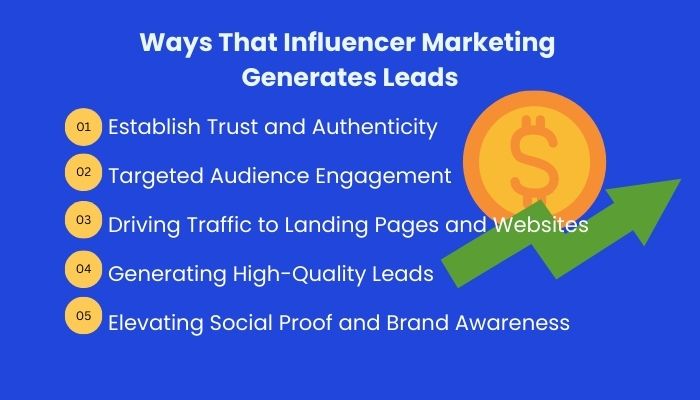
With more than 50 million influencers worldwide, businesses have plenty of options to work with. But that doesn’t mean your company can succeed with just any influencer. It’s important to do your homework and find an influencer with followers that are natural fit for your brand.
The truth is that the right fit matters and can make or break your digital marketing strategy. Depending on who you ask, businesses should invest between 5% and 10% of revenue on digital marketing. When earmarking that amount on anything, you need to know what you’re doing. Otherwise, you might fritter away financial resources on strategy doomed to failure.
Here are some things to consider to ensure you get maximum impact when using influencer marketing for lead generation:
1. Find the Right Influencers
2. Create a Clear Campaign Strategy
3. Run Special Promotions
5. Track and Measure Performance
6. Establish Long-Term Relationships with Influencers
When developing an influencer marketing strategy, you’ll want to avoid missteps. Making any of the following mistakes will lead to wasted time, effort, and valuable financial resources:
1. Choosing the Wrong Influencers
2. Ignoring Authenticity
3. Failing to Set Clear Goals and KPIs
4. Failing to Track Performance and ROI
Influencer marketing has become a reliable driver of lead generation -- giving companies another way to find, reach, and engage with their target demographics. But understanding the importance of influencer marketing and developing a winning strategy that yields measurable results are two separate things.
At Marketer.co, we have the expertise to ensure you get results, including a measurable ROI. Get in touch today to learn how we can help -- whether you’re a startup, a Fortune 500 enterprise, and somewhere in between -- to develop an impactful influencer marketing plan.
.jpg)

Paid lead generation can be a game-changer for your business – when done correctly. Whether you’re running Facebook ads, Google Ads, LinkedIn campaigns, or any other paid lead strategy, the right approach can drive a steady stream of prospects into your funnel. But too many businesses make costly mistakes that drain their budgets without delivering meaningful results.
If you’re struggling to see a return on your paid lead generation efforts, chances are you’re making one (or more) preventable mistakes.
The good news? Once you identify them, they’re fixable. Let’s take a closer look at what might be going wrong – and how you can turn things around.

From a big picture perspective, it’s important to begin by understanding how paid lead generation compares to organic lead generation (and how they fit into a larger strategy). Because, while both ultimately play a role in a well-rounded marketing strategy, they work in very different ways.
Organic lead generation focuses on attracting potential customers without directly paying for ads. This typically involves long-term strategies like search engine optimization (SEO), content marketing, social media engagement, and email marketing. While organic methods require patience, they often produce sustainable, high-quality leads at a lower long-term cost.
The downside? Organic strategies take time to build momentum, and competition for visibility can be tough.
Paid lead generation, on the other hand, involves investing in advertising to quickly generate leads. This can include pay-per-click (PPC) campaigns, social media ads, display ads, and sponsored content.
The biggest advantage of paid lead generation is speed – you can start seeing results almost immediately. You also have greater control over targeting, allowing you to reach specific demographics, interests, and behaviors. However, without careful management, paid campaigns can become expensive, and the leads you generate may not always be as high-quality as those who find you organically.
For the best results, businesses should use a combination of both. Organic strategies help build long-term credibility and trust, while paid lead generation fills the gaps by driving immediate traffic and accelerating growth.
If you get it right…that is.
As mentioned, there are several costly errors that businesses often make with the paid side of their lead generation strategies. And if you make these same mistakes, it could really hurt your results.
A lot of businesses fail to reach the right people with their paid strategy. If you’re casting too wide a net, you’ll end up wasting money on clicks and impressions that don’t convert. On the flip side, if your targeting is too narrow, you might miss out on potential leads who are actually a great fit.
Before you even think about launching a paid campaign, you need a clear picture of who your ideal customer is. Start by building a detailed customer persona that includes demographics (age, gender, income, job title, location) as well as psychographics (pain points, interests, motivations, buying behaviors).
For example, if you're marketing a high-end financial service, your ideal customer might be a mid-career professional earning over six figures, interested in wealth management, and searching for strategies to minimize taxes. Without a well-defined persona, your ads may attract people outside your target market, leading to wasted ad spend and low-quality leads.
One way to build this profile is by analyzing existing customer data. Look at your current clients and ask these three questions:
The more granular you get in defining your audience, the better you can tailor your paid ads to reach the right people.
You can also use platform-specific targeting features to further home in on your audience. Every advertising platform has its own set of targeting tools designed to help you reach your ideal customer. The mistake many marketers make is using a one-size-fits-all approach rather than leveraging these features to their full potential.
If you’re running Facebook or Instagram ads, take advantage of interest-based targeting and lookalike audiences. You can target users based on their behaviors, interests, and interactions with similar brands. Lookalike audiences allow you to reach new people who resemble your existing customers – making them more likely to convert.
You can have the best targeting in the world, but if your ads aren’t compelling, they won’t convert. Weak headlines, bland copy, and uninspiring visuals lead to low engagement, which results in higher ad costs and fewer leads.
Here are a few ways you can fix this:
Even if your ads are performing well, a bad landing page can kill conversions. If you’re sending traffic to a page that’s slow, cluttered, or lacking a clear next step, your paid leads won’t turn into actual customers.
Speed matters more than you think. Studies show that even a one-second delay in load time can reduce conversions by up to 7 percent, and pages that take longer than three seconds to load lose nearly half of their visitors. Slow-loading pages create frustration, increase bounce rates, and waste your ad spend by driving users away before they even see your offer.
To improve load speeds, start by optimizing your images – large, high-resolution images take longer to load, so compress them without sacrificing quality. Use next-gen formats like WebP instead of PNG or JPEG for faster rendering. Next, minimize unnecessary scripts by eliminating third-party tracking codes or plugins that slow down the page. If you’re using WordPress, disable plugins that don’t serve a critical function.
Another game-changer is using a content delivery network (CDN), which caches your landing page on multiple servers worldwide, ensuring faster load times no matter where your visitors are located. Services like Cloudflare or AWS CloudFront help significantly in improving speed and reducing latency.
With more than 60 percent of web traffic coming from mobile devices, you’ll also want to make sure you have a mobile-friendly landing page. A page that looks great on desktop but isn’t optimized for mobile will cause users to abandon it within seconds, costing you valuable leads.
To make sure your landing page is fully responsive and easy to navigate on any device, use a mobile-responsive design. Most website builders and landing page tools offer responsive templates that automatically adjust layouts for different screen sizes. Test your page across multiple devices (smartphones, tablets, etc.) to ensure everything looks and functions correctly.
Many businesses treat lead generation as a numbers game: get as many leads as possible and hope they convert. But if you don’t have a follow-up strategy in place, you’ll lose out on valuable opportunities. Thankfully, there are a few solutions to this issue:
Paid lead generation isn’t something you can set and forget. If you’re not constantly analyzing and optimizing your campaigns, you’re leaving money on the table and potentially wasting your budget on strategies that don’t convert. Successful lead generation requires ongoing monitoring, testing, and adjustments to ensure that every dollar spent is working toward your goals.
To improve your results, start by setting clear key performance indicators (KPIs). Before launching a campaign, define what success looks like for you. Are you aiming for a specific cost per lead (CPL)? A target conversion rate? A certain return on ad spend (ROAS)? Without measurable objectives, it’s impossible to determine if your campaign is performing well or if adjustments need to be made.
Once your campaign is live, monitoring your analytics should become a regular habit. Use tools like Google Analytics, Facebook Ads Manager, or LinkedIn Campaign Manager to track important metrics, such as click-through rates, engagement levels, and cost per conversion. If you notice that certain ads or targeting strategies aren’t delivering the expected results, make changes quickly rather than letting underperforming campaigns drain your budget.
It’s also a good practice to constantly be testing everything. A/B testing different elements – such as headlines, images, ad copy, landing pages, and audience segments – can reveal what resonates most with your audience. Even small tweaks, like changing the wording of a call-to-action or adjusting the placement of a form, can lead to significant improvements in conversion rates.
At Marketer, we work with some of the biggest brands to help build and scale advanced digital marketing strategies that bring in more leads and customers. Want to learn more about how we can help you with strategy, planning, or execution? Contact us today!

When it comes to sales and marketing, not all leads are created equal. Some prospects are ready to buy immediately, while others are just beginning to explore their options. If you spend too much time chasing unqualified leads, you risk wasting resources and missing out on high-value opportunities. That’s where lead scoring comes in.
Lead scoring is a systematic approach to evaluating and ranking prospects based on their likelihood to convert. By assigning scores to leads generated based on their behaviors, demographics, and engagement, you can prioritize your outreach, improve efficiency, and close more deals. If you’re not using lead scoring yet – or if your current system isn’t delivering results – this guide will walk you through the essentials of how to implement and optimize it.
Lead scoring is a method used by sales and marketing teams to rank potential customers based on their interest, engagement, and fit with your ideal customer profile. Each lead receives a numerical value, which helps your team determine which prospects to focus on first. Higher scores indicate leads that are more likely to convert, while lower scores suggest they may need more nurturing before they’re ready to make a purchase.
A well-defined lead scoring system ensures that sales teams focus on high-quality prospects rather than chasing every lead that enters the pipeline. It also improves collaboration between marketing and sales by setting clear expectations for when a lead is ready to be handed off.
To build an effective lead scoring model, you need to consider multiple factors that indicate a prospect’s readiness to buy. These typically fall into two main categories: explicit data and implicit data.
Explicit data includes firmographic and demographic information that helps you determine whether a lead is a good fit for your business. Common factors include:
Implicit data is based on a lead’s interactions with your brand. These behavioral signals indicate their level of interest and engagement. Key examples include:
Combining explicit and implicit data allows you to create a balanced scoring model that identifies leads with both a high level of interest and a strong likelihood of becoming a customer. This produces a better overall system.
A successful lead scoring system requires a structured approach. Follow these steps to build a model that works for your business.
Start by identifying the characteristics of your most valuable customers. Look at your existing customer base to determine common traits among your highest-value clients. Consider factors such as industry, company size, job title, and pain points.
Analyze past conversions to determine which actions signal strong buying intent. For example, do most customers request a demo before purchasing? Do they read multiple blog posts or visit your website several times before reaching out? Pinpoint these key behaviors so you can weigh them appropriately in your scoring model.
Once you’ve identified the attributes and behaviors that matter most, assign point values based on their level of importance. For example:
.jpg)
Conversely, negative scoring can be applied for behaviors that indicate a lack of interest. For example:
This ensures that your scoring model stays dynamic and doesn’t waste resources on cold leads.
Determine the score at which a lead becomes an SQL – meaning they’re ready for outreach from sales. Leads who don’t meet the threshold should remain in the marketing funnel for further nurturing.
Lead scoring isn’t a one-time setup. Regularly review your model to ensure it accurately predicts conversions. Work with your sales team to gather feedback on lead quality and make necessary adjustments to your scoring criteria.
Even with the best intentions, many businesses make mistakes when implementing lead scoring. Here are some pitfalls to watch out for:
Not all prospect actions carry the same weight when it comes to predicting conversion. One of the biggest mistakes businesses make is assigning the same point value to vastly different activities. For example, someone who downloads a free eBook should not receive the same score as someone who requests a product demo.
If you fail to prioritize high-value actions, your lead scoring model may overinflate the importance of low-intent behaviors. Instead, focus on identifying which actions most reliably predict an actual sale. A lead who visits your pricing page multiple times or watches a product demo video should receive significantly more points than someone who simply follows your company on social media.
Many companies build their lead scoring models solely around behavioral factors, such as website visits or email opens, without considering whether the lead is even a good fit for their business. This results in sales teams chasing leads who might be highly engaged but ultimately not a good match for your product or service.
To avoid this, incorporate demographic and firmographic data into your scoring model. Is the lead in your ideal industry? Does their company size match your target market? Are they in the right geographic region? These factors should influence your lead score just as much as behavioral signals. A lead who interacts frequently with your content but doesn’t fit your customer profile shouldn’t be prioritized over a less-engaged lead who perfectly matches your ideal customer.
For a lead scoring system to be successful, your sales and marketing teams need to be on the same page. Too often, marketing teams define lead scoring models without input from sales, leading to misaligned expectations. If marketing hands off leads that sales doesn’t find valuable, it creates friction and results in wasted effort.
To prevent this, hold regular meetings between sales and marketing to discuss which leads are converting best and what key behaviors indicate readiness to buy. Sales teams have firsthand experience with which prospects are the most likely to convert, so their insights should shape your scoring criteria. When both teams collaborate, the lead scoring process becomes much more effective.
Most businesses focus on assigning positive scores to leads based on desirable behaviors, but they overlook the importance of negative lead scoring. Negative lead scoring removes points from a lead’s overall score when they exhibit behaviors that indicate disinterest or lack of fit.
For example, a lead who unsubscribes from your emails, visits your careers page (suggesting they’re job-hunting rather than shopping for your product), or has gone inactive for several months should have points deducted from their score. Without negative scoring, your sales team may continue to pursue leads who have already disengaged, leading to wasted effort.
Lead interest isn’t static – if someone interacts with your brand but doesn’t take action for months, their intent likely decreases. Yet many companies fail to implement lead decay in their scoring models. Lead decay means that as time passes without engagement, a lead’s score gradually decreases to reflect the reduced likelihood of conversion.
For example, if a lead downloads a whitepaper today, it might earn them 10 points. But if they don’t engage further within 30 days, those points should slowly diminish. This ensures that your sales team isn’t prioritizing leads that were once active but are now cold. Regularly refreshing your lead scores based on engagement helps keep your pipeline filled with prospects who are truly ready to buy.
Your business likely serves multiple customer segments with different needs, yet many companies build a single lead scoring model that treats all prospects the same. This can be a major oversight, as the behaviors and characteristics that indicate sales readiness may vary across different customer groups.
For example, if your company serves both small businesses and enterprise clients, the buying journey for each group will be different. A small business owner might make a decision quickly after downloading an eBook, while an enterprise buyer might need multiple touchpoints over several months. Trying to apply the same lead scoring criteria to both groups can lead to inaccurate prioritization.
Instead, consider segmenting your lead scoring model based on different personas or customer types. This allows for more accurate scoring and ensures that leads are evaluated based on the specific journey they are likely to take.
A lead scoring model is not a set-it-and-forget-it system. Market trends change, customer behaviors evolve, and sales strategies shift over time. If you don’t periodically review and refine your scoring model, it will quickly become outdated.
Schedule regular reviews – at least quarterly – to analyze your lead scoring effectiveness. Look at data to see if high-scoring leads are actually converting into customers. If not, you may need to adjust how you assign points or incorporate new factors. Engage with your sales team to get feedback on the quality of leads they’re receiving and make adjustments accordingly.
Any business can create a marketing strategy. The question is, does the strategy get results?
At Marketer.co, we don’t just build fancy strategies with colorful graphs and spreadsheets to impress the suits and black ties. We are disciplined, dynamic, and data-obsessed marketers who take pride in building scalable marketing campaigns that drive sustainable growth.
If you want to get better results, we want to talk. Contact us today!
.jpg)
Most of us have had experience with chatbots, either as business leaders or as individual users engaging with them.
In the earliest stages of development, chatbots weren't especially impressive. They were very basic, recognizable, and at times difficult to deal with.
But these days, bots are incredibly effective. It's difficult to differentiate between bots and humans in most contexts. Chatbots are more unique and personalized. And on top of that, they’re suitable for a wider range of applications.
These days, marketers and lead generation specialists are taking an especially close look at chatbots.
But why is this the case? And how can you use chatbots effectively in a modern lead generation strategy?
Chatbots are effective marketing tools because of their ability to broadly automate what would otherwise be intensive manual effort. These bots can be created and trained to simulate a human being in a wide variety of applications, from initial lead qualification to customer service. When deployed effectively, they can strike up conversations and respond to user queries, gather important information from people, and even address their biggest questions and concerns.
Most people are familiar with chatbots in customer service and on websites by now, but they can also function well on social media and in a variety of other channels.
Lead generation unfolds in many forms and across many channels.
So what are the specific ways that chatbots are used in lead generation?

· Superior customer engagement. In most contexts, chatbots can engage with customers in ways that exceed the potential of their human counterparts. This isn't to say that bots are better than humans when it comes to conversation or personability, but bots are much, much more consistent, less prone to error, and are much easier to scale. To handle a million customer queries without creating delays, you might need a million customer service agents – but you’ll only need one sufficiently powerful chatbot.
· Constant availability. Another advantage of chatbots is that they're constantly available. If one of your prospects gets the sudden urge to ask some questions about your product at two in the morning, you won't need to pay a human business development specialist overtime to handle that conversation. You also don't have to force your customer to wait.
· Direct lead qualification. Chatbots have gotten exceptionally skilled at directly qualifying leads. Provided they've been given adequate direction and training, these chatbots can quickly analyze customer intentions, categorize them, and provide you with the necessary data to make effective decisions related to them.
· Personalized marketing opportunities. Automation in customer service and lead generation is nothing new. But chatbots have added an interesting new dimension to this interaction; they can personalize marketing experiences. Modern chatbot interactions give your leads and prospects a much richer, more individualized conversation.
· Customer support and upselling. Chatbots are also useful in providing customer support and even upselling some of your customers. Because this customer service is more personalized, more immediate, and more consistent, it can help you sell more than ever.
· Improved data analytics. Having a network of chatbots in your lead generation strategy also gives you access to superior data analytics. You can gather far more information on far more people and use that data to better shape your lead generation, marketing, and sales approaches.
· Support for flexible growth. One of the greatest advantages of utilizing chatbots is that you can grow much more flexibly. With the right technologies, scaling almost becomes a trivial matter, and it's much easier to handle increasing waves of leads and customers as your influence expands.
With that in mind, there are some limitations associated with chatbots used for lead generation.
· Niches and training. Chatbots aren't always easy to train, especially in complicated or unique niches. Chatbots also need to be trained before you can rely on them. Because of this, you may not have a perfectly competent chatbot to serve your customers out-of-the-box. But if you're willing to put in the time, money, and effort, you can create a chatbot to serve almost any conceivable purpose.
· Lack of personality. Although today's most sophisticated chatbots are somewhat indistinguishable from humans in certain applications, these things still don't have a unique personality. Many prospects and customers will prefer a more authentic, human interaction, and for the time being, chatbots can't provide one.
· Difficulty with complex topics. Even the most advanced chatbots on the market still sometimes struggle with exceedingly complex or deep topics. If a prospect has a sufficiently confusing question, or if they're asking about a sufficiently complicated product, even a well-trained chatbot might not know what to do. But because this is rare, you can always have human agents on standby to step in when necessary.
· Need for high-level direction. Your entire chatbot network is going to be dependent on the high-level direction that you provide them. Without a solid lead generation and sales strategy in place, your chatbots aren't going to generate much new business.
So what tactics can help you use chatbots in your lead generation strategy more effectively?
· Choose the right technologies. First, you need to choose the right technologies and implement them into your business effectively. There are many types of chatbots out there, and you can even choose to develop your own from scratch. Always do your due diligence and make sure that what you're purchasing is going to be a good fit for the organization and your needs.
· Provide ample information and training. The more information and training your chatbots have, the better they're going to be. Make sure they have access to all relevant information, and give them ample feedback to guide them in their development. The more time you spend on cultivating skilled chatbots, the better they're going to serve you.
· Focus on quality over quantity. As is the case with nearly every aspect of your sales and marketing strategies, you need to focus on quality over quantity. It's very nifty that chatbots can handle extremely large volumes of leads and prospects, but if you aren't proactive in cultivating quality leads, it's going to come back to haunt you. Every element and every stage of your approach needs to be focused on generating quality leads.
· Test, test, test. Don't just assume that your chatbots are working the way you intended, or even the way that you trained them. You need to test them, thoroughly and often, to make sure that they're serving your mission.
· Integrate with human-led conversations. Chatbots are amazing for their ability to handle large volumes and serve people consistently, while also saving time. Humans are amazing for their ability to connect personally and think through more complicated matters. Accordingly, your best approach in lead generation is to utilize the best of both worlds.
· Get feedback. Get feedback from your leads, prospects, and customers. It's hard to tell whether your chatbots are improving your brand’s reputation unless you have actual, objective feedback from people who have interacted with them. Use short surveys to gather opinions.
· Scale deliberately. It's tempting to scale quickly and aggressively once you have sufficient automation in place. But if you want to be effective, and retain more customers, you need to scale thoughtfully and deliberately. If you grow too quickly, you might spread your resources too thin or miss critical problems that are holding your strategy back.
Are you interested in utilizing the full power of chatbots in your lead generation strategy?
Are you ready to get more value out of your lead generation investment?
Our team of lead generation and marketing experts is ready to help you at every stage of your journey.
So if you’re ready to start the conversation about small business lead generation, contact us today!

Regardless of your industry, strategic lead generation is your ticket to profitability, especially in a competitive market. Without a steady flow of prospects, you’ll struggle to generate sales. Although the fundamentals of marketing never change, the methods and strategies that get quality leads are constantly evolving. Each social media platform and other advertising channels require a slightly different approach. For example, what works on Facebook won’t necessarily work on TikTok, and some markets are virtually non-existent on Instagram.
Advertising your products and services is important, but if you aren’t growing your email list at the same time, you’re missing out on future, long-term sales. If you want to generate hot leads in 2025, you need strategies that work on every platform.
Lead generation is the first step toward:
· Building an email list of potential customers
· Generating sales from people interested in your brand
· Increasing brand awareness
All three of these factors are crucial for driving revenue. By prioritizing lead generation, you’ll build a database of potential customers who are already interested in what you offer. With the right strategy, converting those leads into paying customers becomes a smoother, more predictable process.
In general terms, a lead is an individual who expresses interest in your brand through actions like joining your email list, downloading a free resource, scheduling a demo, or buying a product or service. However, not all leads are equal and each type of lead requires a different approach to convert. Understanding the different types of leads is important, since each requires a unique approach to move them closer to conversion.

Marketing Qualified Leads: These are leads who have engaged with your advertising campaigns in some way, but are still doing research. This group includes people who have joined your email marketing list by downloading a free guide, or clicked on a PPC ad, showing curiosity, but not commitment.
Sales Qualified Leads: These leads have demonstrated the intent to purchase by taking actions like adding products to their cart, requesting a consultation, or asking pre-purchase questions. These are the leads your sales team will contact for a conversation or appointment because they are ready to buy.
Product Qualified Leads: These individuals have experienced your product or service firsthand, either through a free trial, a sample, or some type of free plan. They’re engaged and need a small amount of nurturing to convert into paying customers.
Service Qualified Leads: These leads are existing customers who have expressed an interest in upgrading, renewing, or purchasing additional products or services. They already trust your brand, so they’re typically the easiest leads to convert.
When you run a lead generation campaign, you’ll collect leads that fall into all of these categories. As you nurture them through various emails, many of them will progress through your funnel and become paying customers.
Now that we’ve briefly touched on the different types of leads, let’s dive into the strategies. Whether you’re a small business, a large corporation, an entrepreneur, or a startup, the following lead gen strategies will help you generate, nurture, and effectively convert your leads into buyers.
Your website has the potential to be a lead generation machine when optimized properly. Every targeted visitor is a potential lead, and the goal is to guide them toward taking action, whether it’s signing up for your email list, downloading a freebie, or buying a product or service.
Optimizing your website to capture leads begins with making it easy for visitors to get on your email list, whether you offer a lead magnet or just ask people to sign up for updates. You should have a visible signup form on every page, but you’ll want to pay special attention to your landing pages.
Unlike your regular website content, high-converting landing pages are specifically crafted to capture leads by offering something of value in exchange for a visitor’s email address. These pages are simple, clutter-free, and draw the user’s focus to your offer. The copy should include a compelling headline, persuasive copy, a strong call-to-action (CTA), and benefit-driven messaging to make your offer irresistible.
Lead magnets make it easy to capture emails, but the type of lead magnet matters. You have to know your audience extremely well to understand what they’ll find interesting and valuable enough to download. For example, if you’re in a highly technical field, you can probably hand out white papers and exclusive information, but if you’re a retail business or software company, discounts and free trials will be more effective.
Additional ways to optimize your website for lead gen include:
· Using pop-ups. Whether it’s an exit-intent pop-up or a form that shows up a few seconds after a page is loaded, pop-ups will help you capture more leads.
· Implementing dynamic forms. A dynamic web form will adjust its length based on user behavior. First-time visitors will be given a shorter form, while repeat visitors who have shown purchase intent will get longer forms, allowing you to capture more information.
· Using a chatbot. An AI-powered chatbot can engage visitors with questions and capture their email address on the spot.
Once you capture leads, you’ll need to implement email marketing to nurture and convert them over time. Email marketing is where all the magic happens. By creating a strategic email sequence for your leads, you’ll keep your brand at the top of their mind, build trust, and gradually move them through your sales funnel until they’re ready to buy.
Email marketing begins with a welcome email sent to every new lead. This is the perfect opportunity to make a good first impression by thanking your leads for subscribing, deliver your lead magnet, introduce your brand’s mission, and provide a clear next step you’d like them to take. Your welcome email should be short, friendly, and focused on value. Avoid overwhelming your leads with too much information because they might ghost you.
The next component in an email marketing strategy is segmentation. Not all leads are equal, and treating them the same will create missed opportunities. Segmentation is the key to sending the right message to the right people. By categorizing your leads based on their interests, behaviors, and demographics, you can craft highly targeted emails that generate better engagement and more conversions.
For example, if you run a pet store, you’ll want to segment your list based on what type of pets people own so you can send personalized content. Specific and relevant emails will generate higher open rates and more sales. For instance, dog owners will get emails about things like chew toys and training tips, while cat owners will get deals on scratching posts and information about feline nutrition.
Content marketing done right will educate, engage, and nurture leads until they’re ready to buy. By offering valuable, insightful, and relevant content, you’ll position your brand as a trusted authority while guiding prospects through your sales funnel.
There are many components to content marketing, but one of the most effective strategies is to publish authoritative content to your blog and optimize each post with an offer, like access to free resources that solve a problem for your market. For instance, if you offer a free ebook, webinar, or exclusive report, the right audience won’t hesitate to sign up. From there, you can use search engine optimization (SEO) to make your content show up in search results.
Paid ads are an excellent way to generate leads, especially since most platforms now have ad formats that collect email addresses seamlessly within the app. Instead of being taken to your website, when a user clicks your ad, a form will pop up and ask for their email address. When the user submits the form, they’re returned to their feed.
However, while lead forms are fast and easy, sometimes directing traffic to your website is the smarter move. For instance, if your goal is to educate people or showcase detailed product benefits, sending leads to a dedicated landing page can drive more conversions.
Video marketing for lead gen is no longer optional; it’s essential. According to survey data, 87% of consumers say a video has influenced a purchase, and 84% of marketers say video content has directly increased their sales. If you’re not leveraging video content for lead generation, you’re leaving money on the table. Videos help you generate leads by facilitating:
· Engaging stories. Instead of forcing people to read walls of text, videos allow you to tell a story in a more engaging way.
· Product demonstrations. Showcasing your products and services in real-time makes it easier for people to see the value in your offer.
· Customer testimonials. User-submitted video testimonials can convert even the most skeptical prospects.
· Live streams and webinars. Live, real-time interaction is worth its weight in gold for building relationships and trust.
· Short-form content. Attention spans are at an all-time low, and short-form video content can capture interest quickly, and unlike short text, which requires effort to read, video content is absorbed effortlessly.
No matter where you publish your videos, be sure to ask viewers to sign up for your list at the beginning and end of each video.
Artificial intelligence isn’t just for sci-fi movie plots anymore – it’s now a marketing essential. Generative AI chatbots in particular are helping businesses deliver the personalized marketing experiences that drive higher conversions.
A generative AI chatbot can help you convert leads by answering pre-purchase questions and providing information needed to make a confident buying decision. These chatbots use advanced Natural Language Processing (NLP) to provide instant, human-like responses in a conversational tone. Unlike chatbots of the past, AI-powered chatbots don’t regurgitate scripted answers; they are contextually aware and responses are tailored to an individual’s needs.
When your chatbot isn’t answering pre-purchase questions, it can upsell or cross-sell relevant products to potential buyers. For example, say a prospect is browsing your website at 3am and they engage with your company’s chatbot to ask a few questions about a product. Your chatbot can provide product details, suggest complementary items, share customer reviews, and offer a special discount, all while you’re asleep.
But it doesn’t stop there. Your chatbot can also be programmed to collect the user’s email address, ensuring that even if they don’t convert on the spot, a company representative can follow up and keep the conversation going. According to recent data, ecommerce businesses using chatbots see an average email open rate of 85% and a click-through rate (CTR) of 40%. That’s significantly higher than traditional email marketing. So, while you’re catching up on other important tasks, your chatbot will be hard at work engaging leads, personalizing their experience with your brand, and driving revenue all on autopilot.
It’s no longer an option to stick to one social media platform. With some exceptions, brands should have a presence on all the main social media sites, like Facebook, Instagram, TikTok, YouTube, and Twitter/X. Your leads are everywhere, and you should be, too.
Each social media platform has its own strengths, weaknesses, and ideal way of targeting a market. For example, Instagram is ideal for showcasing visually-appealing products (or at least creating aesthetically-pleasing marketing images) and is perfect for influencer marketing, LinkedIn is ideal for B2B leads, and TikTok is ideal for impulse purchases and promoting lead magnets. When it comes to Twitter/X, the ideal is to engage in thought leadership and trending conversations, while YouTube is perfect for publishing educational content and product demos.
Social media can serve as a tool for brand discovery and top-of-funnel awareness for lead generation. You’ll find all kinds of leads on different platforms, and you’ll have to experiment to find out what approach works best on each platform.
Successful marketing in 2025 is about getting the right leads from the start. The businesses that will thrive from here on out will be the ones that embrace AI, automation, and personalized marketing while delivering immense value to their customers.
The good news is you don’t have to figure it all out. At Marketer.co, we specialize in cutting-edge lead generation strategies that actually work. Whether it’s implementing an AI chatbot on your website, spearheading email campaigns that generate sales, or multi-channel social media strategies, we can help you turn more leads into paying customers. Contact us for a free consultation to assess your current lead generation strategy and uncover more opportunities to reach your market. Get in touch with us today and start turning your leads into revenue.

On the surface, lead generation and demand generation sound like different names for the same concept.
Leeds and demand definitely share a relationship. If you generate more demand for your product, you'll end up with more leads, and if you can generate more leads, you’ll naturally benefit from greater demand.
However, while there is some overlap between lead generation and demand generation, it's ideal for marketers to treat these strategies as distinct – and integrate both of them into your overall approach.
What exactly are the differences between lead generation and demand generation?
And why does your business need to use both?

Let's start with the basics.
Demand generation is all about stimulating demand and interest in products like yours. This process is often somewhat passive and focused on inbound approaches, and it doesn't always result in newly generated leads or customers. The goal is to create a landscape in which more people are aware of your brand and the reason it exists – and in which People are primed to think about or even buy products like yours.
Demand generation prioritizes the following:
· Introducing the problem. On the demand side of the equation, you typically focus on the problem more than the solution. If you're selling food, you first need to stimulate hunger. There's nothing wrong with introducing your solution or product at this stage, but the primary motivation of your actions should be to make people recognize that they need your solution or product.
· Highlighting brand authority. This is also an excellent opportunity to highlight your brand authority. Brand visibility plays an important role in both demand generation and lead generation, but it's especially valuable to establish your authority before you attempt to call your prospects to action.
· Utilizing free and accessible media. At the demand generation stage, most people are going to feel somewhat apathetic toward your brand. That's why it pays to use free and accessible media. People are much more likely to read articles, watch videos, and engage with social media content if it's freely available, and that's exactly what you want in the demand generation phase.
· Engaging a wide audience. Demand generation also requires you to engage a wide audience. At this point, you're focused on quantity as much as quality, since you're effectively “priming the pump” of customer demand. You may not have a concrete idea of who your best customers are going to be, so it's beneficial to cast the widest possible net.
· Top of funnel focus. Demand generation prioritizes action at the top of the sales funnel. At this stage, people may not even be aware of the problem they're facing. It's your job to introduce that to them, so they can feel comfortable and confident moving to the next stage of the funnel.
In contrast, lead generation is about taking advantage of the demand you've already generated so that you can cultivate more prospects and eventually customers. Most companies practicing lead generation use a mix of both inbound and outbound strategies, across a multitude of different channels.
Lead generation prioritizes the following:
· Introducing the solution. If you want someone to be interested in your product, you need to pitch it to them as a solution for a problem they know they're facing. If you have a good demand generation strategy in place, you probably have a multitude of prospects who are aware of a problem and are in search of a solution. This is your opportunity to introduce it to them.
· Highlighting specific benefits. Lead generation also enables you to highlight specific benefits of your product or service. There's nothing wrong with showcasing your brand authority and expertise at this stage, but if you want to convert people, you need to give them compelling reasons to do so. The more specific your pitch is, and the more persuasive it is, the better.
· Utilizing gated resources and media. During the lead generation stage, you need to get something from your audience. Depending on your strategy, that could mean persuading people to buy your products and services or simply getting them to provide their contact information. Either way, you need to utilize gated resources or media. Give people better-quality, premium resources in exchange for their contact information.
· Engaging a narrow audience. Instead of casting a wide net, lead generation typically benefits from engaging with a narrower audience. There's nothing wrong with generating a lot of leads, but you're typically better served focusing on quality over quantity. This way, you can reach the people most likely to buy from your brand – and avoid wasting time on people who aren't a good fit for it. Many lead generation strategies also include processes for ongoing lead nurturing, capitalizing on quality leads who didn't convert the first time around.
· Bottom of funnel focus. In contrast to demand generation, lead generation focuses on the bottom of the funnel. By this point, many of your prospects are going to be intimately familiar with your brand and its products, so you'll just have to close the deal.
There are many good reasons why you might focus on demand generation as part of your overarching marketing approach:
· Countless options. For starters, demand generation gives you countless options. Because you're focusing on a broad audience, and not a highly specific one, and because you're more focused on getting attention and stimulating thought than driving specific action, you can engage with people in practically limitless ways. You can take advantage of dozens of different free channels and experiment with a wide variety of tactics to drive results.
· A big net. This is also one of your best chances to cast a wide net and appeal to as many people as possible. Not everyone who interacts with your demand generation materials is going to become a loyal customer, but you don't need them to. You simply need to raise awareness of the problem your brand is trying to solve and make your brand more visible.
· Long-term value. Demand generation is a long-term strategy that yields results for years to come. Even if someone who engages with your demand generation materials doesn't buy from your brand right away, your brand will become more familiar to them, so they're more likely to buy from you in the future. They may even be more likely to recommend your brand to friends and family members who are ready to buy. Because of these effects and others, you can capitalize on demand generation dividends indefinitely.
· Secondary benefits. There are also some secondary benefits associated with demand generation. It's not just about stimulating thought and interest in your products; it's also about reengaging with customers who have already bought from you and building the credibility and broader familiarity of your brand.
There are many perks associated with lead generation as well:
· Harnessing the full power of demand. Lead generation is the best way to capitalize on power of the demand you generated – as well as whatever demand already innately existed for your product. With a focused, targeted approach, you can reach out to the people who are most interested in your products and most likely to buy from you so that you can persuade them more specifically.
· Quality selections. If demand generation is more about quantity, lead generation is more about quality. Instead of spamming a million people in the vague hope that some of them will go out of their way to engage with you, you can reach out to the select few people most likely to engage with you – and appeal to them directly.
· Cost effectiveness. If your lead generation strategies are sufficiently effective, they should yield a very strong return on investment (ROI). Demand generation should have a positive ROI as well, but it's harder to measure and takes longer to develop. By optimizing your lead generation strategy for results, you can get more value out of every dollar you spend.
· Systematic clarity. Lead generation strategies give you much more concrete feedback to work with. If someone declines to purchase your product in a phone conversation, you can ask them what's holding them back. If some of your inbound tactics have a lower conversion rate than others, you can study the data to learn what the differences are and readjust your approach. As long as you take this feedback seriously, you can gradually refine your approaches and significantly improve your results down the line.
Do you really need both lead generation and demand generation? A couple of simple thought experiments can help you decide.
First, let's think about what a company might look like if it focuses on lead generation without demand generation. It's capable of achieving relatively high conversion rates and targeting the people most likely to purchase specific products, but people may not be familiar with the brand and there will be fewer people even aware that a problem exists. In this scenario, the company might be genuinely pleased with results; if traffic is reasonable and conversion rates are high, the company can achieve profitability and relatively sustainable growth.
However, this company might be blind to the potential it could achieve with the help of demand generation. Because demand generation produces more potential leads to target and enriches your customer pool by showcasing brand authority and building familiarity, it greatly multiplies the impact of your lead generation strategy.
An even clearer example of why you need both is a hypothetical in which you utilize demand generation without lead generation. In this scenario, you've made thousands of people aware that there's a problem they need to solve – and you've potentially introduced your brand to them. This will almost certainly have an impact on your bottom line, driving more people to your business and improving engagement with your existing customers.
However, you'll never be able to harness the full potential of your demand generation without a lead generation strategy at the bottom of your funnel. You may have more people aware of the critical problem, but you're not pushing people to take action, nor are you specifically targeting the people most likely to buy from you.
Ultimately, the best approach for nearly every business is to use demand generation and lead generation together. With both of these strategies overlapping and connecting with each other, you'll be able to stimulate more interest, engagement, and ultimately conversions.
Of course, this can be a tricky puzzle to solve. How much, exactly, should you be investing in each side of this equation? How should you use tactics that could conceivably fit into either demand generation or lead generation? How can you use insights gleaned from one strategy to improve the other? And what do you do if you hit a dead end?
If you're relatively new to the digital marketing world, or if you've had unsatisfactory marketing results in the past, you may not know how to begin answering these questions. That's why it pays to work with a seasoned marketing agency, which can offer the expertise and insights necessary to help you create and execute the best possible mix of demand generation and lead generation.
If you’re ready to get started, reach out for a free discovery call today or take a look at our ultimate guide to lead generation!

LinkedIn has become one of the most powerful platforms for B2B lead generation. It’s where professionals go to network, share insights, and search for solutions to their business problems. With the right strategies, you can use LinkedIn to connect with decision-makers, showcase your expertise, and generate quality leads for your business.
If you’re looking to transform LinkedIn into your go-to platform for lead generation, here’s a step-by-step guide to help you get started.
Your LinkedIn profile is your digital storefront. It’s almost always the first impression potential leads will have of you, so it needs to be polished, professional, and value-driven.

Start with a professional headshot that conveys confidence and approachability. This should be a simple, distraction-free picture of you. Don’t use a picture of you at the most recent wedding you attended – cropping out the person next to you. And don’t choose a photo that’s five or ten years old. It should be a professional headshot taken within the past 18 months.
Next, craft a compelling headline that goes beyond your job title. Highlight what you do and how you help others. For example, instead of “CEO at XYZ Solutions,” write something like, “Helping SMBs Streamline Operations Through Custom Software Solutions.” The more specific and niche-focused your headline is, the better.
Your About section is prime real estate for showcasing your expertise and value proposition. Use it to tell your story, highlight your achievements, and make it clear how you can solve problems for your target audience. Include keywords relevant to your industry to boost your visibility in LinkedIn searches.
LinkedIn is all about connections, but it’s not just a numbers game. The quality of your network matters more than the quantity. Focus on connecting with individuals who fit your ideal customer profile, including decision-makers, influencers, and other key stakeholders in your target industries. (Thankfully, LinkedIn makes it easy to sort and filter when searching for connections.)
When sending connection requests, personalize your message. Mention why you’re reaching out or reference a common interest, group, or piece of content they’ve shared. This small effort can significantly increase your chances of a successful connection.
As your network grows, regularly engage with your connections by liking, commenting on, or sharing their posts. This keeps you on their radar and helps build relationships over time.
LinkedIn Groups are an underrated but highly effective way to connect with your target audience. By joining groups relevant to your industry or niche, you can engage in conversations, share insights, and position yourself as an expert in your field.
Focus on being helpful and providing value. Answer questions, share useful content, and avoid coming across as overly promotional. Over time, this builds trust and opens the door for potential leads to reach out to you directly.
You can also create your own LinkedIn Group tailored to your niche. Invite professionals who fit your target demographic and foster discussions around industry trends, challenges, and solutions. As the group’s moderator, you’ll be in a prime position to build relationships and generate leads.
Consistent, high-quality content is one of the best ways to attract and engage your audience on LinkedIn. When sharing posts, articles, and updates that provide genuine value, you can showcase your expertise, which keeps your brand top of mind.
Creating high quality content is probably the number one thing people struggle with and ask about (when it comes to winning with LinkedIn). With this in mind, here’s how to create content that resonates:

When creating content, always encourage engagement. You can do this by asking questions, inviting opinions, or creating polls. The more interactive your content, the more likely it is to generate meaningful conversations that lead to business opportunities.
LinkedIn’s Advanced Search feature is a powerful tool for finding potential leads. You can filter results by location, industry, company size, job title, and more to pinpoint exactly who you want to reach.
Once you’ve identified potential leads, take the time to research their profiles. Look for commonalities, such as shared connections or mutual interests, that you can mention in your outreach. Personalized messages are far more likely to get a response than generic ones.
Consider saving your searches to revisit them regularly and identify new leads as they join LinkedIn or update their profiles.
If you’re serious about B2B lead generation, investing in LinkedIn Sales Navigator can be a game-changer. This premium tool offers advanced search filters, lead recommendations, and insights into your prospects’ activities, allowing you to create more targeted and effective outreach campaigns.
Sales Navigator also lets you save leads and accounts, track their updates, and get alerts when they post new content or change roles. This helps you stay informed and reach out at the right time with a relevant message.
Cold outreach on LinkedIn can work, but only if it’s done thoughtfully. Generic, copy-paste messages will likely end up ignored or deleted. Instead, craft personalized messages that show you’ve taken the time to understand your prospect’s needs.
Start by referencing something specific from their profile, such as a recent post, shared connection, or career milestone. Clearly explain why you’re reaching out and how you can add value.
For example: “Hi [Name], I noticed your post about [topic] and found it really insightful. I work with companies like yours to [solve a specific problem or achieve a specific goal]. Would you be open to a quick call to discuss how we might collaborate?”
Keep your messages short, professional, and focused on building a relationship rather than making an immediate sale.
If you have a budget for paid advertising, LinkedIn Ads can be an excellent way to generate high-quality B2B leads. The platform’s advanced targeting capabilities allow you to reach specific audiences based on factors like job title, company size, industry, and location.
Some of the most effective LinkedIn ad formats for lead generation include:
Experiment with different ad types and track your performance metrics to refine your campaigns over time.
Like any marketing effort, success on LinkedIn requires ongoing analysis and adjustment. Use LinkedIn’s analytics tools to track key metrics, such as profile views, post engagement, and connection requests.
Pay attention to which types of content, outreach strategies, and campaigns generate the most leads, and double down on what works. Don’t be afraid to experiment with new approaches or pivot if something isn’t delivering results.
LinkedIn is a powerful starting point for lead generation, but it’s only the beginning. Once you’ve established a connection, move the relationship forward by scheduling calls, meetings, or in-person events.
Focus on building genuine relationships and providing value at every stage of the process. Whether it’s sharing insights, offering free resources, or connecting them with others in your network, these small gestures can go a long way in turning a prospect into a loyal client.
In order to build a successful brand in the 2020s, you need a cohesive, far-reaching digital strategy that puts you in front of the right people in the right places at the right times. At Marketer.co, we exist for the purpose of helping individuals and businesses create and implement marketing strategies that get results. Contact us today to learn more about how we can help!

Does your lead generation strategy need some more “oomph?” Blogging might just be your secret weapon. Not only will it keep your website fresh, but it can make Google happy, impress your market, and turn casual browsers into committed paying customers. Now, before you start generating leads, you’ll need to have an email marketing system set up to capture email addresses.
Let’s explore how blogging can fuel your lead generation tactics and work 24/7 on your behalf.
Articles you publish are like a magnet – except they attract potential customers, not rusty nails. Publishing fresh, new content to your blog periodically gives Google something new to look at, which can improve your rankings in the search results.
According to the data, websites with blogs get 55% more traffic than websites without a blog; you can’t afford to miss out on that extra traffic.

Traffic is nice, but we’re talking about generating leads here, right? Traffic is just the first step in acquiring leads through your blog. Once your content begins to show up in search results, you’ll have traffic, but there’s no guarantee they’ll convert. That’s where additional digital marketing strategies come into play.
Turning traffic into leads is done by:
· Writing convincing copy.
· Keeping people on the page.
· Keeping your web pages distraction-free.
· Having a good offer (usually this is a lead magnet).
· Making sure your offer matches your market’s needs.
· Having a compelling CTA.
· Capturing exiting traffic through pop-ups.
Let’s explore each of these components in-depth.
Once you have someone on your website reading your blog, you’ll need persuasive copy to convert them to an official lead. This includes using compelling headlines, outlining clear benefits for whatever it is you’re selling or giving away, and a directive telling them what to do next (also known as a call-to-action CTA).
If your blog article happens to be about something more general, and isn’t a direct sales pitch, you can insert your persuasive copy with a CTA at the end of your blog. In fact, this is good practice to do with every blog post you write.
It’s easier to get conversions when you’re pulling in targeted traffic, but people still tend to bounce fast if they don’t like what they see in the first few seconds. This is where interactive content can be helpful, if it’s relevant to your niche.
Quizzes, calculators, and niche-related assessments can be a great way to keep people engaged, and get them to sign up for your email list. People love getting personalized results from quizzes.
If interactive copy doesn’t work for your niche, you’ll need to rely on compelling headlines and possibly images or video to capture attention.
Leads convert better without distractions, so make sure your blog blends into your website seamlessly. Don’t make it fancy with elements all over the place. Keep it simple and direct the focus to your email capture form.
Originally, blogs had sidebars and looked somewhat like a newspaper, with a bunch of stories laid out all over the place. Unless you’re publishing an actual news blog, keep your design as simple as possible. Sidebars are good for desktop users, but on mobile, they just get in the way since they’re displayed in-line.
A lead magnet is something you offer in exchange for a visitor’s email address, and it needs to be good to work. People are inundated with emails and the last thing they want is to sign up for yet another list – unless you have something irresistible to give them.
A typical lead magnet is a PDF file, like an ebook, cheat sheet, white paper, or guide. Other effective lead magnets include links to watch a webinar, or a generous discount.
Lead magnets work because people love free stuff – especially if it solves a big problem or gives them insight into something they care about. However, it only works when the offer is aligned with your market’s interests. For example, if you’re a fitness coach, a “Meal Prepping for Busy Professionals” guide could be your golden ticket.
Don’t guess at what your market wants. Conduct market research to find out what your market’s pain points are, and use that information to create an irresistible offer that solves their pain.
A good CTA will gently nudge your visitors into taking the action you want them to take – like signing up for your email list. Make your CTAs action-oriented and benefit-driven, such as “Get Instant Access” or “Claim Your Spot Now.” Don’t forget to tell people what to do. The average visitor won’t take action unless prompted.
Place CTAs at various points throughout your high quality content. The best places are at the end of your blog posts, in pop-ups, and sometimes they work great in the middle of popular or long posts.
Exit-intent pop-ups are the best thing since sliced bread. This is a type of pop-up that appears when a user moves their mouse off the page, as if they’re about to close the browser window or tab.
Just because someone decides to leave your page doesn’t mean they can’t be converted. For instance, using an exit-intent pop-up can convert an extra 2%-4% of visitors and boost revenue by 30%.
Every time you publish an article on your blog, it’s like sending a love letter to Google, but without the awkwardness. The more posts you have, the more pages Google can index, which increases your chances of being found in the search engines. Statistics show that regular blogging can generate 434% more indexed pages in search engines.
While not every web page you publish will rank high, the best ones will generate traffic and bring you some qualified leads. The key is to start slow and keep a steady pace. Don’t publish 30 blogs in 30 days if you don’t plan on maintaining that flow. There is no exact number of articles you should publish in a set amount of time, but it’s generally advised to publish at least a couple every month.
SEO isn’t as straightforward as it used to be, now that Google uses more than 200 different ranking signals and nobody knows exactly how the algorithm works. However, there are several things you can do without having to hire a professional SEO agency.
Start by making sure your entire website is optimized with the basics of technical SEO, and then focus on writing valuable content. You can use keyword research tools, like Ahrefs or Semrush to find ideal keywords and phrases related to your niche, and then write your articles around those terms while keeping the focus on providing value.
Guest posting – a form of content marketing strategy– is a great way of generating high quality leads, but not all sites are created equal. To make it an effective lead generating strategy, you only want to guest post for websites that are in your niche. To get relevant traffic, you need to share a market with the site where your guest posts are published. Your ideal and valuable leads are people who are already interested in what you offer.
The fastest way to start guest posting is to look for blogs in your niche that accept guest posts. However, avoid sites that require payment because this can get you in trouble with Google. The best partnerships are ones that are mutually beneficial. Meaning, you’ll provide a quality article for the publisher’s target audience and in exchange, they’ll let you promote your products and services.
Everyone has a business or individual they consider a trusted authority on important topics. If you want people to think of your brand as an authority, blogging can help you earn that expert reputation in your niche.
Being a trusted brand in your niche can help you get not only leads, but immediate sales. In fact, 56% of people say they’ve bought something from a company after reading a blog post.
Building authority and trust with your audience is the cornerstone of successful blogging. Generally speaking, authority is earned by demonstrating expertise and knowledge, while trust is cultivated through consistency, transparency, and genuine connection. Here’s how to master both when you blog:
· Publish high-quality, well-researched, in-depth content. Readers trust blogs that cite their sources while delivering actionable and insightful content. The deeper you go, the more your expertise will shine.
· Highlight your credentials. If you have degrees, certifications, or if you’ve won awards in your industry, make sure your readers know. You can place your qualifications and accomplishments in the “about” section of your website, or in your author bio that shows up with each blog post.
· Write posts that address common problems or questions in your niche. Use credible sources when backing your claims, and try to include real-world examples from your own experience when possible.
· Post consistently. Reliability fosters trust. When readers can count on you to post regular content, they’ll be more likely to view you as an authority.
· Take a stand. Controversy tends to divide people, but that’s a positive thing when it comes to the lead generation process. When you take a stand on controversial topics relevant to your industry, you will divide people. However, the people who agree with you will become fiercely loyal, as opposed to your audience just being moderately interested. Your loyal fans will spend more money with you and bring more leads your way.
· Engage with your audience. When you interact with your audience, they feel heard and understood, and it shows them that you’re genuine. Respond to emails and social media posts when possible, especially when people have questions, concerns, or complaints. Doing this can actually help drive social media conversions.
You already know you’re an expert in your field; you just have to earn that reputation with your market. When your blogs effectively showcase your expertise, they help capture leads and turn them into qualified prospects.
When you deliver consistent, high-quality, valuable content through your blog, you build a relationship with your leads that makes them want to stick around for more. Although it’s not as direct as email marketing, it still works. Companies that nurture their leads generate 50% more sales.
Blogging allows you to nurture leads at every stage in the customer journey, even before they sign up for your email list. Some people read blogs for months or years before signing up. Don’t skip this valuable component.
Blogging can work some serious magic for your business if you give it a try. With benefits like increased traffic, better SEO, and more trust, it would be a shame to ignore this worthwhile strategy. Blogging isn’t just a trend – it’s one of the best lead generation strategies around. So get those words flowing and watch your leads grow faster than your to-do list on a Monday morning.
Are you struggling to turn your website visitors into quality B2b leads? If you feel like your lead generation ideas have hit a plateau, our lead gen experts are here to help. From creating winning strategies to publishing effective lead-capturing content, we’d love to work with you.
Contact us today for a free consultation to learn more about how we can help you turn traffic into qualified leads.

.svg)